The Sad Laugh
Act 1
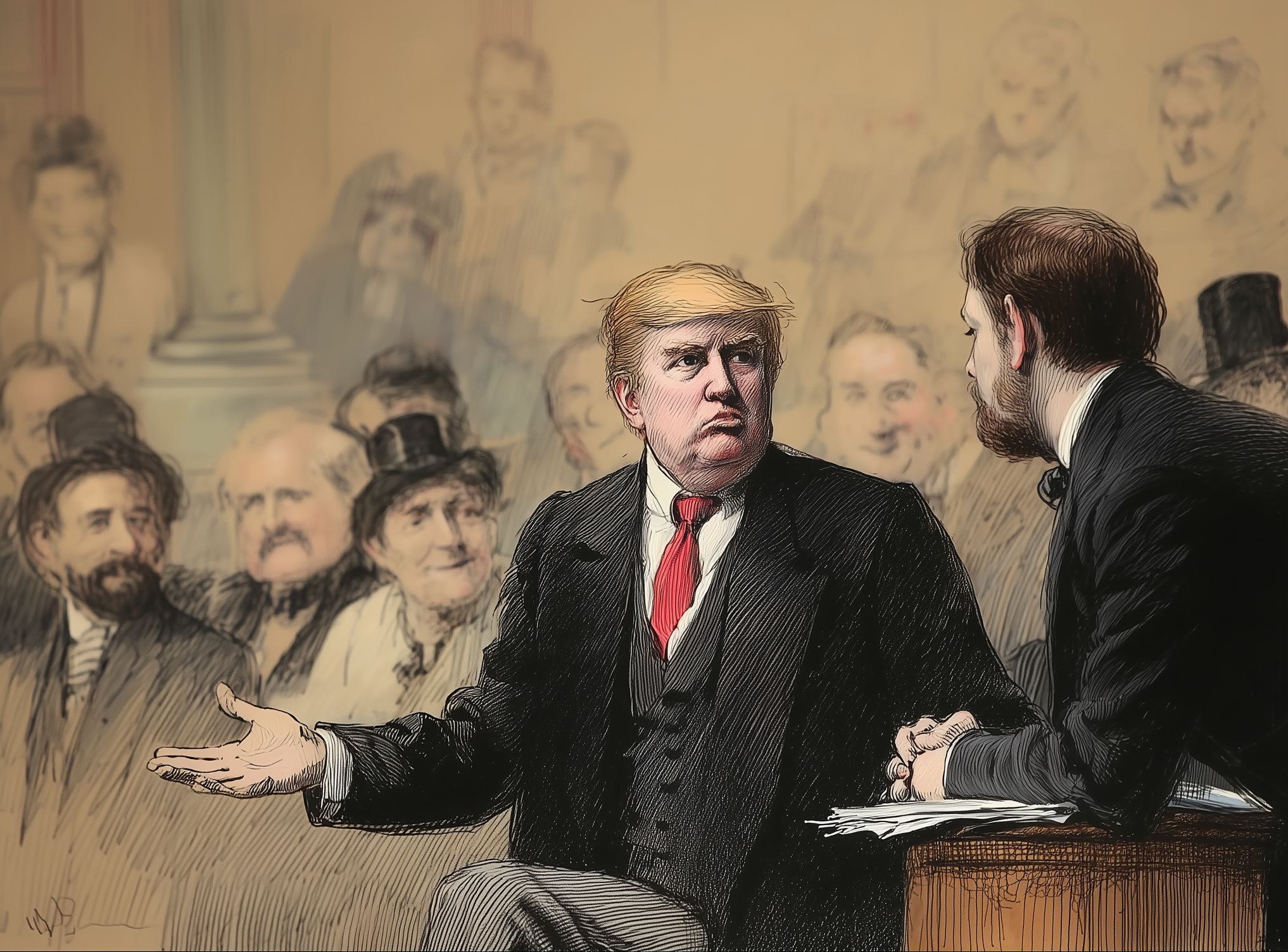
It was July 18, 2015, and the room was full of the faithful.
The Family Leadership Summit in Ames, Iowa, draws the kind of Republicans who show up early and stay late, the ones who believe the party still belongs to them. Frank Luntz was on stage doing what Frank Luntz does—tossing softballs to presidential hopefuls, letting them audition for the base. When Donald Trump sat down, Luntz asked about John McCain.
This was, on paper, a gimme. McCain was the party's most recent presidential nominee, a senator, a naval aviator who had been shot down over Hanoi and spent five and a half years in a prison camp being beaten and broken. When his captors discovered his father was an admiral and offered him early release, McCain refused. He would leave when his fellow prisoners left. He stayed. He endured. Whatever you thought of his politics, the man had done something most of us will never be asked to do and cannot imagine doing.
Trump gave a small shrug, the kind you'd use for a waiter who brought the wrong wine. "I supported him. He lost. He let us down." A beat. "I don't like losers."
Luntz, to his credit, pushed back. McCain was a war hero.
"He was a war hero because he was captured," Trump said. "I like people who weren't captured."
Then came the laugh.
Not silence first—though you might expect it. Not a gasp, not the intake of breath that follows a car wreck. There was a half-second of something, a held beat where the room tested the weight of what had just been said. A man had just called a tortured prisoner of war a loser on a stage in front of hundreds of Christian conservatives in the middle of Iowa. The raw cruelty of it sat there, exposed, waiting to see what would happen next.
What happened next was laughter.
Not nervous laughter. Not the uncomfortable titter of people who don't know how to respond. It was real laughter, the kind that releases something. The room had made a decision together, in that beat, and the decision was that this was funny. That this was permitted. That a man who couldn't escape his torturers was fair game for mockery, and that mocking him felt good.
I've watched the clip more times than is probably healthy. The simple explanation for that laugh is tribalism. Trump was their guy—or becoming their guy—and crowds laugh at whatever their guy says. The laughter was a loyalty signal, not a moral verdict. This explanation is comforting because it contains the damage. It means the audience wasn't endorsing the content, just performing affiliation. It means you could swap in a different joke and get the same response.
But it doesn't account for the relief in that room. Watch it again. The laughter has a quality of release, like a pressure valve opening. Something was permitted that hadn't been permitted before. The audience wasn't just going along with Trump; they were grateful to him.
The other common explanation is simpler: cruelty. These were cruel people who enjoy seeing others humiliated. Trump gave them what they wanted, the way a comedian gives a crowd what it wants. This explanation is also comforting, in its way, because it makes the problem about them—a specific subset of bad people with bad character. If that's true, the rest of us are off the hook. We just need to outnumber them.
But that doesn't quite fit either. The people in that room were not, by any reasonable measure, a gathering of sociopaths. They were churchgoers, small business owners, parents, people who coach Little League and bring casseroles to sick neighbors. They would not, most of them, laugh if you showed them a video of a man being tortured. They would be horrified. So why did they laugh when Trump called that same man a sucker for having been tortured?
You don't have to guess what frame Trump was using. He told us. Thirty seconds before the POW line, he said it plainly: "I don't like losers."
McCain lost the 2008 election. That made him a loser. McCain was captured in Vietnam. That, too, made him a loser. The logic is airtight once you accept the premise. Winning is the only virtue. Losing is the only sin. Everything else—sacrifice, endurance, honor, the decision to stay with your men when you could have gone home—is either a win or a loss, and if you're in a cage, you lost.
In the moral universe Trump was constructing in real time—a universe the audience recognized, because they had been living in it their whole lives—losing is not a thing that happens to you. Losing is a thing you are.
Act 2
That moral universe didn't come from nowhere.
Americans have been marinating in a particular story about success and failure for so long that it feels less like ideology and more like weather. The story goes like this: America is the land of opportunity. Anyone can make it if they work hard enough, believe in themselves, and refuse to quit. The corollary, never stated but always implied, is that if you haven't made it, something is wrong with you. You didn't work hard enough. You didn't believe. You quit.
This is the story we tell in commencement speeches, Super Bowl ads, and political campaigns. It's the story of the bootstrap, the self-made man, the overnight success that was actually years of grinding in obscurity. It's an inspiring story when you're on the way up. It becomes a very different story when you're stuck, or sliding backward, or never got a fair shot in the first place.
Because if success is a choice, then failure is too. And if failure is a choice, then the people who are failing—the ones losing their farms, watching their factories close, burying their kids from overdoses, putting groceries on credit cards—aren't victims of a rigged system. They're just losers. They didn't want it badly enough. They made bad decisions. The universe is functioning exactly as designed, and they got what they deserved.
This is what sociologists call the just-world hypothesis. It's the belief that outcomes track merit, that the cream rises, that the market is a sorting mechanism for human worth. Venture capitalists believe it about their portfolios. Megachurch pastors preach it as prosperity gospel. Parents who got lucky believe it about their parenting. It is the unofficial religion of American capitalism, and its primary function is to make the winners feel virtuous and the losers feel ashamed.
Shame like that doesn't fade. It’s a slow burn, and the smoke sticks to your clothes.
If you've spent decades being quietly assessed as less-than, for working with your hands, for not going to college, for living in a town that coastal newspapers only visit to write about despair, you learn what it feels like to be looked at as a loser. Not by anyone in particular. By the culture. By the assumption that if your town is dying, it must be because the people there made bad choices. By the reality-TV shows and tech billionaires and politicians who radiate the message that winners live in cities and losers live where you live.
Over time, that judgment goes from stalker to complaining tenant. And one of the ways people survive it is by redirecting it. You find someone lower on the ladder, or someone you can push lower, and you look at them the way you've been looked at. Not because you're a bad person. Because the alternative is feeling the full weight of the contempt yourself, and that's unbearable.
Psychologists who study hierarchy and dominance have a term for this: Social Dominance Orientation (SDO). It's a measure of how much a person believes the world should be organized into winners and losers, with the winners on top and the losers knowing their place. High-SDO individuals tend to see life as zero-sum. They're comfortable with inequality because inequality is natural, correct, the way things should be. They don't just tolerate hierarchy—they prefer it.
And here's what the research shows, consistently, across multiple studies: Social Dominance Orientation is one of the strongest predictors of support for Donald Trump. Stronger than income. Stronger than education. Stronger than church attendance, rural residence, or any of the demographic variables pundits usually reach for. The thing that most reliably predicts whether someone loves Trump is whether they believe in a world organized by dominance, where strength deserves reward and weakness deserves contempt.
This isn't an insult. It's a measurement. And it suggests that what happened in Ames wasn't a fluke or a gaffe that somehow didn't matter. It was an audition. Trump was testing a message—losers deserve what they get—and the crowd was telling him, with their laughter, that he'd found the frequency.
But Trump didn't invent that frequency. He detected it. The hatred of weakness was already there, built up over years of being told that your struggles are your fault, that the economy is a meritocracy, that the rich are rich because they're better, and the poor are poor because they're worse. Trump just said it out loud, in plain language, without the usual genteel wrapping.
He speaks fluent self-contempt. That's his gift, if gift is the right word. He takes the voice that has been whispering you're a loser to millions of Americans, and he points it outward—at immigrants, at elites, at captured soldiers, at anyone who can be framed as weak. And when he does, something releases. The people laughing in that room weren't celebrating cruelty for its own sake. They were celebrating the moment when the gun turned around and pointed at someone else.
Act 3
So there's Trump, who found the frequency. And there's an audience that was already tuned to it. But a rally in Iowa isn't a political movement. A laugh isn't a governing coalition. Something has to connect the performer to the crowd and both of them to power.
This is where it helps to think in layers.
The first layer is Trump himself. Whatever else he is, he's a reader of rooms. He has spent his entire adult life figuring out what people want to hear and saying it with absolute conviction, whether it's true or not, whether he believes it or not. This is not a skill to dismiss. Most politicians are terrible at it. They hedge, they triangulate, they speak in focus-grouped mush. Trump speaks in headlines. He says the thing that other people are thinking but have learned not to say, and he says it like he's proud of it.
That's his contribution to the coalition: permission. He makes it to say what was previously not to be said out loud. He mocks the people his audience resents, the elites, the experts, the immigrants, the liberal losers, and he does it without apology. The wall between private contempt and public discourse comes down, and suddenly a roomful of Iowans can laugh at a tortured POW without feeling like they've crossed a line. Because the line has been moved. Trump moved it.
But Trump alone is just a man with a microphone. The second layer is the machinery that amplifies him and translates his impulses into policy.
This layer includes the think tanks that spent years preparing for a president willing to use executive power aggressively. It includes the lawyers who've developed theories for why the president can ignore Congress, fire independent officials, and treat the executive branch as an extension of his personal will. It includes the donors who fund it all, the politicians who fall in line because the base rewards loyalty and punishes dissent, and the media ecosystem that wraps the whole thing in a 24-hour feedback loop of grievance and affirmation.
This machinery wasn't built specifically for Trump. Much of it was under construction for decades, waiting for someone who would actually use it. What Trump provided was the total absence of shame around pushing boundaries that previous Republicans approached carefully. The machinery said: here's what's possible if you're willing to take the heat. Trump said: I don't feel heat.
The result is a kind of convergent evolution. Trump needed infrastructure to turn rallies into governance. The infrastructure needed a frontman who could keep the base inflamed. Neither created the other, but they recognized each other immediately.
And beneath both of them, the third layer: the people who show up.
This is where the story gets complicated, because the base is not a monolith. The crowd that laughed in Ames contains multitudes—some wealthy, some struggling, some college-educated, some not, some driven by economics, some by culture, some by faith. What holds them together isn't a single demographic profile. It's a set of shared feelings.
There's the feeling that something has been stolen. That the country you grew up in is being taken away by people who don't share your values and don't respect your way of life. That elites in distant cities make decisions that hurt you and then call you a bigot when you complain.
There's the feeling that the system is rigged; not in the way a Bernie Sanders voter might mean it, with talk of billionaires and tax policy, but in a more primal sense. The feeling that the rules keep changing and somehow you're always on the wrong side of the new rules. That people who break the law get amnesty, while you follow the law and get nothing. That your kids can't say "Merry Christmas" in school but have to learn about pronouns.
And underneath it all, there's the feeling that strength is being punished and weakness is being rewarded. That America used to be a place where you could speak your mind, compete hard, and win, and now it's a place where winners are told to apologize and losers are handed trophies.
This is where Trump's frequency and the base lock into sync. He's not offering policy. He's offering a world where strength is admired again, where winners don't have to apologize, where the people who've been looking down on you finally get what's coming to them. The laugh in Ames was the sound of that all clicking into place.
A significant portion of this base believes America was always meant to be a certain kind of nation, one where their values, their faith, their people are at the center. They see the last several decades as a long decline from that vision, a slow theft by secular forces, by immigrants, by academics and activists who want to remake America into something unrecognizable. Some of them believe, literally, that Trump's rise is providential, that God placed him in this moment to turn back the tide.
When you believe you're fighting for God's plan, compromise looks like betrayal. Norms look like obstacles. A leader who breaks the rules isn't a threat to democracy; he's a champion who refuses to be shackled by a corrupt system.
This is the architecture. A performer who gives permission. A machinery that translates permission into power. A base that feels seen and Christ-blessed and finally, finally represented by someone who fights the way they want to fight, without apology, without restraint, without the weakness of playing by rules that were rigged against them anyway.
Act 4
Here's what happened after the laugh.
Pundits declared Trump's campaign dead. The McCain line was a gaffe too far, an insult to veterans that no candidate could survive. Republican operatives started writing postmortems. The consensus was swift and unanimous: this was the moment Trump had finally gone too far.
He won the Iowa caucuses seven months later. He won the nomination. He won the presidency.
And something strange happened to that clip from Ames. It didn't become a cautionary tale. It became a founding document. The laugh wasn't evidence of a campaign's collapse. It was evidence of its thesis. Trump had found something in that room—something that wanted to be found—and the rest of the country spent the next decade trying to explain it away.
We called it a cult of personality. We called it economic anxiety. We called it misinformation, Russian interference, Facebook algorithms, a failure of the Democratic Party to speak to working people. We called it anything other than what it was, because what it was implicated more than just Trump.
The laugh told us what we were dealing with. We didn't want to hear it.
We didn't want to hear it because the laugh wasn't strange. It was familiar. We recognized the frequency even if we didn't want to name it. The contempt for weakness, the worship of winners, the quiet understanding that losers deserve what they get—none of that was invented in Ames, Iowa in 2015. It was in the air we'd been breathing our whole lives. In the bootstrap mythology. In the prosperity gospel. In the way we talk about poverty as a moral failing and wealth as a sign of virtue. In the American insistence that outcomes are earned, which means that anyone at the bottom must belong there.
Trump didn't create a new politics. He held up a mirror to an old one. The reflection was ugly, so we blamed the mirror.
That's the embarrassment, if we're honest. Not that we failed to528 stop him—though we did. Not that we underestimated his appeal—though we did that too. The embarrassment is that we kept asking the wrong question. We kept asking, "How can people support him after he said that?" As if the cruelty was a bug. As if the insults were gaffes he kept surviving despite their offensiveness.
They weren't despite. They were because.
The laugh was the tell. A room full of ordinary people heard a man mock a tortured prisoner of war, and they laughed with relief, because someone had finally said out loud what they had been trained to believe in silence: that weakness is shameful, that losers deserve contempt, that strength justifies itself. They weren't misled. They weren't manipulated. They heard the message clearly, and they liked it.
We're ten years past Ames now. The man who called McCain a loser is in his second term. The laugh has become policy, become appointment, become the governing philosophy of a major political party. And we're still acting surprised. Still treating each new cruelty as an aberration. Still asking how his supporters can possibly tolerate this, as though tolerance is what's happening, as though they're holding their noses rather than finally breathing freely.
The laugh is not a mystery. It's an answer. We just don't like what it tells us about the country we thought we lived in.