A History of How We Win
Chapter 1: Rescued by thousands
On a Friday night in March 1854, Joshua Glover was playing cards in his cabin outside Racine, Wisconsin, when someone knocked on the door.
He told his friends not to open it.
Rumors had been circulating for days. Slave catchers in town. Federal marshals asking questions. Glover had been free for nearly two years, working at the sawmill, living in his own cabin, sleeping in his own bed. He'd walked over three hundred miles to get here. He'd chosen his own name. And now, at the sound of knuckles on wood, all of it balanced on a knife's edge.
The door came off its hinges.
Seven men rushed in. John Kearney, a St. Louis deputy marshal, clubbed Glover in the face with a heavy wooden bludgeon, then again with the butt of a pistol. Glover fought, outnumbered seven to one, he fought, but they beat him to the ground, cuffed his wrists, and dragged him bleeding into a wagon. A federal marshal put his boot on Glover's neck for the entire twenty-five-mile ride to Milwaukee.
It was perfectly legal. The Fugitive Slave Act of 1850 said so.
And if this were a different kind of story, the kind Americans have been telling themselves for a long time, it would end there. A man captured. A law enforced. The machinery of the state grinding forward, unstoppable, inevitable. What could anyone do?
Long before the internet, people just yelled their posts, or nailed them
By nine o'clock the next morning, a telegram reached Sherman Booth, editor of the Wisconsin Free Democrat and a man who had spent his career making trouble for people who deserved it. Booth rode to the courthouse, confirmed the report, then mounted his horse and did something that would get him arrested, prosecuted, and imprisoned for the next six years.
He rode through the streets of Milwaukee shouting at the top of his lungs:
"FREEMEN TO THE RESCUE! Slave catchers in our midst! Be at the courthouse at two o'clock!"
No phones. No group texts. No social media. Just a man on a white horse scattering handbills and yelling.
By mid-afternoon, five thousand people had gathered outside the jail.
Milwaukee's entire population was maybe thirty thousand. Five thousand of them dropped whatever they were doing on a Saturday and showed up. They didn't know each other. They hadn't planned this. They just came because someone was in trouble, and standing by wasn't something they were willing to do.
The lawyers tried first.
They filed writs of habeas corpus. They petitioned judges. They worked the system because that's what you're supposed to do. And the system did exactly what it was designed to do: a Virginia-born judge announced that Glover would remain in jail until Monday morning, and that "no earthly power" would change that.
So the crowd became other-than-earthly.
Around six o'clock, a group of men seized a timber from a nearby construction site, twenty feet long, thick as a railroad tie, and used it as a battering ram. The jail door splintered. Joshua Glover was freed.
A newspaper correspondent described what happened next: "Imagine four to six thousand persons smashing in the jail, releasing the negro and then running as they could the distance of a mile, and every man in town running too, windows open, handkerchiefs waving..."
Within weeks, Glover was in Canada. He spent the rest of his life there, thirty-four years, working at Montgomery’s, living quietly, dying at seventy-four in a bed he owned. A historian who studied his life noted the most remarkable thing about it: "There was no worry about being sold away to a cotton or sugar plantation... He had ample food, a table to eat it from, and a bed to sleep in... Most of all, he knew that the body that lay itself to rest at night would awaken the next morning still free."
Nine days after Glover walked out of that jail, fifty-three people gathered in a one-room schoolhouse in Ripon, Wisconsin, ninety miles northwest of Milwaukee. They'd come as Whigs and Free Soilers and Democrats. They left as something else. One of them later wrote to Horace Greeley: "We came out of it Republicans, and we were the first Republicans in the Union."
The Glover rescue had, in the words of one historian, "stirred public excitement to fever pitch." It cracked something open. Within six years, the party founded in that schoolhouse would elect Abraham Lincoln and trigger the emancipation of all slaves in America.
Is this too long ago to matter today?
I'm writing this on Thursday, January 29, 2026. Five days ago, a thirty-seven-year-old ICU nurse named Alex Pretti was beaten and shot to death by federal agents on a street in Minneapolis. His crime: filming the agents with his phone and trying to help a woman they had shoved to the ground.
Twenty-one days before that, Renee Good, a thirty-seven-year-old mother, was shot through the windshield of her car by an ICE agent named Jonathan Ross. Her crime: at best, being an American citizen exercising her rights to protest and observe, at worst, trying to maneuver her car on a snow-covered street, and accommodate ICE traffic, as in the car she waved through.
Three thousand federal agents are currently deployed in the Twin Cities. Schools have gone remote. Businesses have closed. Rachel Sayre, the director of Minneapolis's emergency management department, says the conditions remind her of the conflict zones where she's worked: Yemen, Haiti, Syria, Iraq, Ukraine. "A powerful entity is violently and intentionally terrorizing people," she told reporters, "making them afraid to go outside so they can't earn a living and kids can't go to school."
This morning, a federal judge heard arguments on whether Operation Metro Surge violates the Constitution. Minnesota's attorney called it an "unchecked invasion and occupation." He called a letter from the U.S. Attorney General demanding that Minnesota repeal its sanctuary policies "a ransom note." The judge asked the government's lawyers a question that would have made sense in 1854: "Is the executive trying to achieve a goal through force that it cannot achieve through courts?"
This is all so heavy. Many are reeling in emotional despair. I feel it too.
But I didn't start with Joshua Glover because his story has a happy ending. I started with him because his story has a lesson, and the lesson isn't "things worked out in the end."
The lesson is that 5,000 people showed up with no plan, no organization, and no reasonable expectation of success, and they changed the course of American history in an afternoon. Not because they were special. But because doing nothing wasn’t an option.
Thousands of ordinary people decided that the laws on the books were less important than the moral laws in their hearts.
And they reminded a country of a fundamental principle written into our Declaration of Independence, “That whenever any Form of Government becomes destructive of these ends, it is the Right of the People to alter or to abolish it…when a long train of abuses and usurpations, pursuing invariably the same Object evinces a design to reduce them under absolute Despotism, it is their Right, it is their Duty, to throw off such Government…”
So what can we do? How do we win?
To answer, we need to, as Mr. Peabody used to say, “Sherman, set the Wayback machine to the year 1850.” After that, we will be making several more stops through our history, between then and now.
Chapter 2: The Machinery
We head back to September 26, 1850. 58 Water Street in lower Manhattan. A man named James Hamlet works as a porter at Tilton & Maloney's general store, the same job he's held for 2 years.
Mr. Hamlet lives in the Williamsburg neighborhood of Brooklyn with his wife and two children. He's an active member of the African Methodist Episcopal Zion Church. He left Baltimore for New York in 1848 and built a life in a city where the growing Black population made him feel safe.
8 days before we meet Mr. Hamlet in Tilton & Maloney’s, the Fugitive Slave Act had been signed into law.
This day, U.S. Marshal Benjamin Tallmadge walks into the store with a warrant signed by Commissioner Alexander Gardiner. A Mrs. Mary Brown of Baltimore claims Mr. Hamlet is her property. Her son-in-law, Thomas Clare, has come north to retrieve him.
Mr. Hamlet is taken to a room on the second floor of the old City Hall. No one notifies his family. No one assigns him a lawyer. Commissioner Gardiner proceeds "with hot haste," as one witness put it, taking testimony from Mr. Clare and Mrs. Brown's son, Gustavus. By the time a sympathetic attorney arrives, having heard by accident what was happening, the cross-examination is all but over.
Insisting that he was born free, that his mother was a freewoman, Mr. Hamlet swears that he has never been anyone's property. Under Section 6 of the Fugitive Slave Act, his testimony cannot be admitted. The law prohibits it.
Commissioner Gardiner rules for the slaveholder and collects $10 from the federal government. If he had ruled for Hamlet, he would have only collected $5.The official justification for the fee difference was that returning someone to slavery required more paperwork. But everyone knew them as the “$10 Judges.”
Within hours, Mr. Hamlet is in chains, headed for Baltimore. He is taken to Hope Slatter's slave market on Pratt Street and put up for sale.
No trial. No jury. No right to speak in his own defense. Just a commissioner, a piece of paper, and $10 (roughly $400 today).
This is just one example of the machinery of the state at work.
The man who built this example
James Mason, the Senator from Virginia, who today would be called a hateful turnip and an aggressively mid-tier villain. He is the damaged goods upon which our current White House ghoul, Steven Miller, was based. Mason didn't think of slavery as a necessary evil. He thought of it as ‘positive good. And he hated the Northern elite liberals and their ‘personal liberty laws’. He saw them as a direct violation of constitutional property rights.
Northern courts kept finding loopholes that whittled away at the original Fugitive Slave Law of 1793. By 1850, chasing a runaway north was barely worth the trouble.
So he turned his toxic vitriol into a new Fugitive Slave Act. It was meaner, uglier, and far more oppressive than the original. In one portion (Sec. 5), he made it so marshals could "summon and call to their aid the bystanders, or posse comitatus of the proper county."
A federal marshal could grab you on the street, point at a Black man, hand you a pair of handcuffs, and you had to help drag that man to the courthouse, or pay a thousand-dollar fine ($38,000 today).
In another part (Sec. 7 of the law), Mason doubles down on his vindictive hatred of the Northerners by threatening anyone who interfered (sound familiar?) Any support for the colored man was made illegal. Any help you offered could land you in jail. Even the act of keeping quiet when you could have given up a dark-skinned member of your community was a punishable offence.
The bubble that sheltered Northerners from a sense of responsibility was about to pop. The shop keep in Philadelphia, the tailor in the West Village, the butcher in Milwaukee, could no longer hate slavery from afar. It stopped being someone else's issue. It had become their problem.
According to the law, you were either helping catch slaves or you were a criminal. No neutral ground remained. Help ICE or else... sorry, I meant, help the slave catchers or else.
The North had spent decades claiming the morally superior ground.
Now they would have to decide what to risk to maintain it.
Back in the present
January 20, 2025, Trump's first day in office, he rescinds the "sensitive locations" policy that had protected churches, schools, hospitals, and courthouses from immigration enforcement.
"Brayan David Morales Bermudez, 26, hadn't missed a single court date, not even once. The Guatemalan asylum seeker was facing robbery and obstruction charges stemming from a domestic dispute. He hadn't been convicted. The trial had just started that morning. He was doing everything right, following every rule, and showing up when and where he was told to. On January 12, 2026, five masked ICE officers handcuffed him on the sidewalk outside the Clark County courthouse in Washington State. He'd just left a hearing. The one place in America he was legally required to be had become the one place he wasn't safe.
Workplaces and people’s homes were always unsafe.
Leonardo Garcia Venegas, 26, was born in Florida. He was working at a construction site in Baldwin County, Alabama, in May of 2025, when masked agents hopped a fence and ran past the white and Black workers. They went straight for the Latinos. Leo's brother was tackled; his face shoved into wet concrete. Leo started filming. An agent grabbed him, wrestled him to the ground, pulled the REAL ID from his wallet, and told him it was fake. He was detained for over an hour before they bothered to check his Social Security number.
Two weeks later, agents cornered Leo in a half-built house, surrounded him in a bedroom, and detained him again. Same ID. Same story. Same answer: could be fake.
ChongLy "Scott" Thao, 56, has been an American citizen for 35 years. He came to the U.S. from Laos in 1974 at the age of four. On Sunday, January 18th, he was singing karaoke in his St. Paul home when federal agents broke down his door. They dragged him outside in subfreezing temperatures as low as 14 degrees Fahrenheit, wearing boxer shorts and Crocs. His four-year-old grandson's blanket was the only thing covering him. They drove him around for an hour, took his fingerprints, then dropped him back home. No apology. No explanation. The next day, neighbors fixed his door while ICE vehicles idled in the street outside.
"I was praying," Thao told reporters. "I was like, God, please help me. I didn't do anything wrong."
Here’s the thing, the agents in Alabama ran past the white workers. They ran past the Black workers. They went straight for anyone who looked Latino. In Minnesota, they broke down the door of a Hmong family. In courthouse after courthouse, the people in handcuffs share one thing in common: they don't look like the men and women in the current administration order their arrests.
In 1850, the commissioners didn't need evidence. They needed a piece of paper and a Black face. In 2026, ICE doesn't need warrants. They need brown skin and a hunch.
The Fugitive Slave Act let commissioners send a man south in chains without hearing a word of his defense. Today, a REAL ID issued by the state of Alabama can be dismissed as "fake" by a masked federal agent who never has to explain himself to anyone.
The machinery doesn't change. Just the people it grinds up.
Spoiler Alert
The system isn't broken. It's doing exactly what it was built to do.
You don't beat it by proving it's evil. Everybody already knows it's evil.
You beat it by making it cost more than it's worth.
Chapter 3: They kicked a sleeping lion
Amos Adams Lawrence was not a radical. He was a textile magnate. A Harvard man. A Whig who believed in order, commerce, and leaving well enough alone. His family fortune came from Massachusetts mills that spun Southern cotton into Northern profit. The arrangement required discretion and compromise about who picked that cotton. Lawrence had been raised to be upright and practical. Compromise is practical.
He found slavery distasteful, the way comfortable people find distant suffering distasteful, abstractly, from a safe remove, in a way that required nothing of him.
Then came Anthony Burns.
May 1854. Federal marshals arrested Burns. All of twenty years old, escaped from Virginia. He started a new life. He worked in a Boston clothing store. And now he was locked in the federal courthouse. The city erupted. Thousands gathered. Abolitionists attacked the building with axes and battering rams. A federal marshal was killed.
Furious at the interference, President Franklin Pierce sent a telegram: "Incur any expense to ensure the execution of the law." (Sound familiar)
They feds piled on. Fifteen hundred militia. A hundred federal troops with cannon. Marines. Cavalry. Artillery. All to return one man to slavery.
June 2, 1854. They marched Anthony Burns through the streets of Boston. Fifty thousand people lined the route to protest and stand for Anthony Burns. Black crepe on every building. Flags upside down. A coffin suspended over the street with LIBERTY painted on its side. Church bells tolling across the state. The crowd yelled, they spat on the troops, and they wept.
Burns, in chains, surrounded by bayonets, walked through what had to be a surreal tunnel of support.
Amos Lawrence was watching.
Years later, trying to explain the moment, he wrote: "We went to bed one night old-fashioned, conservative, Compromise Union Whigs & woke up stark mad Abolitionists."
Not gradual. Not reasoned. Conversion. One day, he found slavery distasteful in the abstract. The next he was ‘stark mad.’ In modern parlance, he had become “mad as hell, and was not going to take this anymore!”
The Fugitive Slave Act took the abstract distaste for slavery and force-fed it to the white Northerners. Some just swallowed it and looked away. History is full of those who are willing to stuff it down and pretend it didn't happen. But many discovered who they were, morally and ethically. Like Amos Lawerence, they thought they were upright and practical. Turns out they were the kind of people who couldn't watch another human being marched to slavery in chains without becoming mad as hell and unwilling to take it anymore.
The slaveholders had made a bet. Force the North to participate, and participation becomes normal. Complicity buys silence.
They bet wrong.
Moral distance requires maintenance. You have to keep the suffering far enough away that you can continue not thinking about it. The Fugitive Slave Act didn't create distance. It destroyed it.
They built a machine to manufacture compliance. What they got was a machine that manufactured abolitionists.
The privileged bubble of intellectual morality collapsed for Amos Lawrence on June 2, 1854.
The footage from Minneapolis, of not one, but two cold-blooded murders by feds who had been given a blank check by the president, collapsed the same bubble for a lot of people, and not just people in Minneapolis.
Chapter 4: The Many Colors of Courage
A man with nothing to fear
Lewis Hayden lost his family to slavery one piece at a time.
As a child, he watched his siblings being sold at auction. As a teenager, his enslaver traded him for a pair of carriage horses. When he was fourteen, General Lafayette, the Revolutionary War hero on a triumphal tour of America, noticed the enslaved boy and bowed to him.
A small gesture. A seed planted.
As an adult, Hayden married Esther Harvey. They had a son. Then Henry Clay, the Senator from Kentucky, purchased Esther and the child. Clay sold them south. Hayden never saw them again.
In 1844, Hayden married Harriet Bell. She already had a son. Determined not to lose another family, they escaped with help from a Methodist minister and a Vermont schoolteacher. Through Ohio. To Detroit. Across the border into Canada. And finally, in 1846, Boston.
Hayden opened a clothing store. Built a life. Moved to 66 Phillips Street on Beacon Hill.
And he kept two kegs of gunpowder under the front stoop.
When slave catchers came to Boston, Hayden made sure they knew about the kegs. He'd stand in the doorway of a house that had sheltered hundreds of fugitives and explain that if anyone tried to enter, he would light the fuse.
"Go in peace," he told them, "or go in pieces."
They believed him. A man who had lost everything to the machinery of slavery was not bluffing. There was nothing left to take from him.
A city on fire
Boston erupted in virulent opposition to the Fugitive Slave Act.
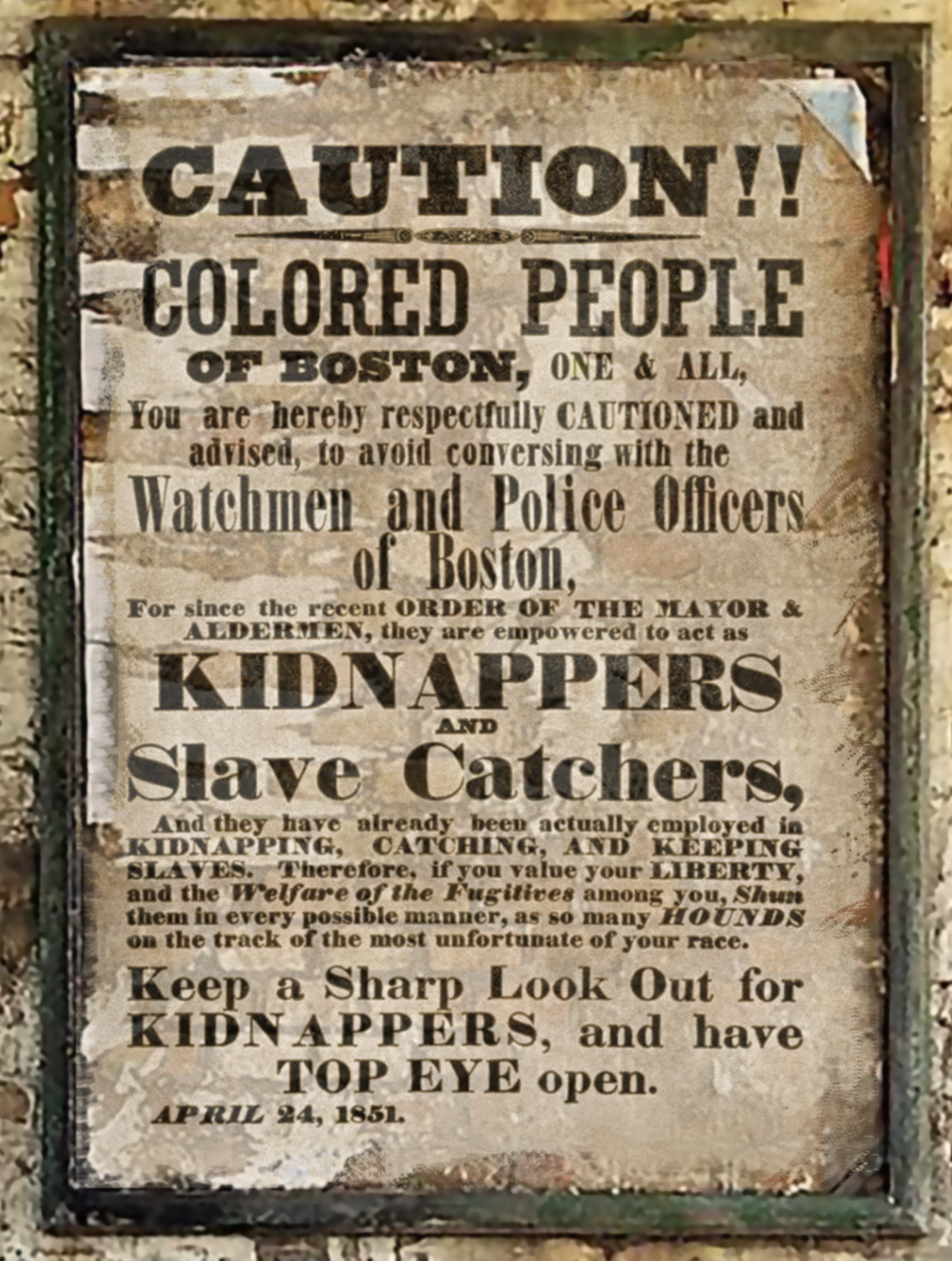
Within weeks of its passage, Black Bostonians gathered at the African Meeting House and formed the Vigilance Committee. They organized safe houses across Beacon Hill. They stationed watchers at the harbor. They plastered the city with warnings: "CAUTION!! COLORED PEOPLE OF BOSTON... KIDNAPPERS AND SLAVE CATCHERS... Keep a Sharp Look Out." An all-Black militia called the Massasoit Guards began patrolling the neighborhoods where Black families lived. The state refused them official status because they were Black. Refused them weapons. So they bought their own.
In February 1851, federal marshals captured a fugitive named Shadrach Minkins. A hundred people stormed the courthouse, overwhelmed the guards, and pulled him out of their hands. Twenty-four hours later, Minkins was in Montreal.
The federal government's response: they wrapped the courthouse in heavy chains. Judges and lawyers had to crouch beneath them to enter the building.
It didn't help.
A couple with everything to live for
October 1850. William and Ellen Craft had been living in Boston for two years, famous in abolitionist circles for one of the most audacious escapes in American history.
Ellen, light-skinned, had disguised herself as a young white slaveholder traveling north for medical treatment. Top hat. Gentleman's clothing. Arm in a sling so she wouldn't have to sign documents. Face wrapped in bandages to hide that she had no beard. William posed as her enslaved servant. A thousand miles through slave country, sitting in first-class carriages beside white passengers who never suspected.
Now two men arrived hunting them.
Angry men with something to prove
Willis Hughes was a Southern lawyer doing legal work for slave owners, including the previous owners of the Crafts. John Knight was a Georgia tradesman who knew the Crafts personally. He bought goods from William Craft’s shop. Now he'd traveled a thousand miles to drag them back in chains.
When they showed up in Boston, a hive of slave-catching-haters came alive.
Watchers spotted Hughes and Knight at the harbor. Handbills went up within hours. "SLAVE HUNTERS IN BOSTON!" Physical descriptions. Hotel names. Streets to avoid. The hunters' faces were on posters before breakfast.
Someone told them to try Lewis Hayden's house. They saw Hayden at the door, kegs under the stoop, armed Black men in the street. They backed away to search less dangerous neighborhoods.
Boston lawyers bullied the bullies
Attorneys from the Vigilance Committee buried them in paper. Hughes and Knight were arrested and rearrested on a carousel of charges: slander, carrying concealed weapons, smoking in the street, swearing in public, attempted kidnapping, and (my personal favorite) speeding while being chased across the Cambridge bridge. Each arrest meant bail. Each bail meant delay. Each delay meant another day the Crafts weren't on a ship back to Georgia.
Shopkeepers refused to serve them. Hotels asked them to leave. Crowds gathered outside their windows at night, jeering, making rest impossible. They came to hunt. They discovered they were prey.
After two weeks, Hughes and Knight fled Boston. They warned others: your safety cannot be assured in this city.
A no-nonsense preacher
Before the Crafts escaped to England, Theodore Parker married them.
Parker was a Boston preacher. Sermons on Sundays. Pastoral visits during the week. The quiet work of a man of God. He kept a loaded pistol on his desk in case slave catchers came for the fugitives he was sheltering.
When he married William and Ellen, he handed William a revolver and a knife along with the marriage certificate.
"I put a Bible into her hand," Parker wrote, "and a sword into his."
When a pastor opens their church as a sanctuary, they invoke an authority higher than the state. That's why clergy have always been dangerous to unjust systems. That's why in the present day, ICE stripped churches of their protected status.
Everybody matters, every action counts
I described in Chapter 3, the arrest by federal agents of Anthony Burns, the twenty-year-old fugitive working in a Boston clothing store. Lewis Hayden helped organize an attempt to storm the courthouse and free him. Theodore Parker was there protesting. Many others rose to the occasion.
They failed. Burns stayed in chains.
The preacher Parker was indicted. Hayden faced charges. The resistance had thrown everything at saving Anthony Burns.
In an effort to cow the people of Boston, President Pierce sent in a military invasion force. On June 2nd, they perp-walked Burns through a crowd of 50,000 protesters. The same crowd that Amos Lawrence was in, triggering his conversion to an anti-slavery activist.
That's the truth about movements. We won’t win every battle. But we don’t stop fighting.
And we don’t all play the same role. For every person who charged that door trying to free Anthony Burns, dozens did something else. Someone spotted Hughes and Knight at the harbor. Someone printed the handbills. Someone posted bail. Someone hid the Crafts. Someone just showed up and added their body to the count.
Different skills. Different risks. Different roles.
The ecosystem needed all of them.
Today, the handbills are group texts. The harbor watchers are Rapid Response Networks. In Minneapolis, crowds gather outside hotels where federal agents are staying, banging pots, blowing whistles, shining lights in windows.
There was a role for everyone in 1850.
There's a role for everyone now.
Chapter 5: Our Citizen Superpower
Let's talk about Anthony Burns one more time. Not the man. The math.
The federal government spent somewhere between forty thousand and one hundred thousand dollars to return Anthony Burns to slavery. In today's money: $1.4 to $3 million. For one person.
Fifteen hundred militia. A hundred federal troops. Marines with fixed bayonets. Cavalry. Artillery with loaded cannon. A revenue cutter waiting in the harbor. All of it to march a single twenty-year-old man from a courthouse to a ship.
A Southern editor looked at the whole disaster and understood exactly what had happened. "We rejoice at the recapture of Burns," he wrote, "but a few more such victories and the South is undone."
He was right.
Anthony Burns was returned to Virginia on June 2, 1854. But, after Burns, not a single fugitive was ever returned from Massachusetts again. Despite the Fugitive Slave Act remaining law for another decade, despite the Supreme Court upholding it, despite the full weight of federal authority available to enforce it.
The law didn't change. The Constitution didn't change. The Supreme Court didn't reverse itself.
The cost changed.
Here's the thing they don't teach you, because it's the thing that makes power nervous:
Governments can only get away with what they can afford. Not just financially, though that matters. Socially. Politically. In terms of legitimacy, public cooperation, and the willingness of the population to let the machinery run without interference.
Every act of enforcement has a cost. If the reaction is indifference, the cost stays low, and enforcement continues. If people start showing up, if the machinery becomes visible, if continuing becomes more painful than retreating, enforcement stops.
Not because anyone suddenly chose right from wrong. But because the math changed.
For centuries, the world over, this is how societies have changed for the better.
In 1934, 1.4 million workers walked off their jobs in 1,865 separate strikes. The country ground to a halt. Even conservative administrations have signed laws protecting the right to organize. Not because he'd become a union man. Because he couldn't afford the alternative.
The suffragists spent seventy years demanding the vote. When lobbying got them nowhere, they picketed the White House for two years straight. When they were arrested, they went on hunger strikes. The authorities force-fed them through tubes shoved down their throats. The images made the government look like monsters. The 19th Amendment passed.
In 1977, disabled Americans occupied federal buildings in ten cities. In San Francisco, 150 people held a federal office for 25 days. Normal operations became impossible. On day 23, the Secretary signed the regulations they'd been blocking for four years.
César Chávez and the farmworkers struck the grape fields for five years. They extended the boycott from California to every dinner table in America. Grape sales collapsed. In 1970, growers who had laughed at them signed contracts covering 10,000 workers.
ACT UP staged die-ins at the FDA while their friends were dying of AIDS. They disrupted every meeting. They made themselves impossible to ignore. The government changed drug approval processes, expanded the definition of AIDS, funded research it had been neglecting for years.
In 2012, two hundred fast-food workers walked out in New York City. Everyone said they were crazy. You can't organize fast food. Within a decade, 26 million workers had won raises totaling $150 billion. Twenty-nine states increased their minimum wage.
Different decades. Different causes. Same mechanism. The beliefs didn't change. The math did.
Here’s the arithmetic up close.
In 1955, Black riders made up seventy-five percent of Montgomery's bus ridership. Seventy-five percent. When Rosa Parks refused to give up her seat and the Black community organized a boycott, the bus company started losing thirty to forty thousand fares a day.
The boycott lasted 381 days.
The bus company didn't desegregate because the owners experienced a moral awakening about racial equality. They desegregated because they were bleeding to death and couldn't stop the bleeding as long as the boycott continued.
Or consider Sidney Smyer.
Smyer was a Birmingham real estate developer, one of the most committed segregationists in Alabama. After the 1963 protests left the city's reputation in ruins and businesses hemorrhaging money, Smyer announced his support for desegregation.
His explanation was bizarrely honest: "I'm a segregationist," he said, "but I'm not a damn fool."
His beliefs didn't change. The cost calculus did.
The question we need to ask ourselves is not "how do we change their minds?"
We usually can't. The people running this machinery are not operating in good faith. They don’t believe in facts or evidence; they believe in believing. If something “feels” right to them, that’s good enough.
The question to ask is, “ How do we raise the cost?”
How do we make enforcement more expensive, more visible, more politically toxic? How do we gum up the works so much that the machinery grinds to a halt? How do we ensure that every act of cruelty generates witnesses, documentation, and consequences? How do we make it harder for comfortable people to look away? How do we make it uncomfortable to stay silent?
Anthony Burns was the last fugitive captured in Massachusetts because fifty thousand people made his rendition cost more than anyone was willing to pay again. The mechanism was crude. It required showing up. Being visible. Making yourself impossible to ignore. It required a city draped in black and voices screaming "Shame!" until they made it too costly to continue.
That’s why it worked
It always works. When the math changes, the machinery stops.
Chapter 6: The Moment That Wasn't
There's a moment, in every society's slide toward darkness, when the outcome is still undecided. When the machinery is running but hasn't yet reached full speed. When the people who will later claim they were powerless are actually making choices every day about whether to resist, comply, or simply look away.
Germany passed through that moment in the early 1930s.
America is in that moment now.
The One-Day boycott that failed forward
April 1, 1933 - Edwin Landau was a shopkeeper in West Prussia. He had fought for Germany in the Great War, bled for it in the trenches. On that morning, a pair of jack-booted Brownshirts painted a big yellow star of David on the shop window and posted themselves outside, telling customers not to enter.
"To me the whole thing seemed inconceivable," he wrote later. "It would not sink in that something like that could even be possible in the twentieth century, for such things had happened, at most, in the Middle Ages."
He watched his neighbors walk past. Some glanced at the Brownshirts and kept moving. Some ducked their heads and went about their errands. A few slipped inside anyway, not out of solidarity but because they needed something.
Landau asked himself a question: "Was there any comrade-in-arms left from that period who felt disgusted by the spectacle he was now witnessing?"
The answer, apparently, was no.
Nobody cared
All across Germany that day, the scene repeated. SA men in their boots and armbands, stationed outside Jewish shops, banks, law offices, medical practices. Stars of David painted on windows. Signs reading "Don't Buy From Jews!" Crowds gathering, curious, wary, watching.
Not embracing. But not resisting either.
Many Germans ignored the boycott and kept shopping. Not because they opposed it. Because they still needed their Jewish doctor, their Jewish tailor. It was convenience, not courage.
The regime called off the boycott after a single day. On the surface, a failure.
But there were no strikes. No counter-demonstrations. No collective action of any kind. Just sixty million people making individual decisions to continue with their lives. The moment passed, and ordinary Germans went back to normal.
Six days later, the regime passed the Law for the Restoration of the Professional Civil Service. Jews were fired from government jobs. Teachers. Professors. Judges. The machinery accelerated.
They had learned what they needed to know. They didn't need Germans to be enthusiastic. They just needed them to look away.
The machinery now had the lubrication of indifference. They were able to scale hatred unimpeded.
This is Charlotte, be like Charlotte
On February 27, 1943, the Gestapo arrested the last Jews remaining in Berlin. Among them were 1,800 men married to non-Jewish German women. Charlotte Israel's husband, Julius, was one of them.
Charlotte was thirty-two, blonde, with what was considered model Aryan features. The SS had once asked her to participate in the Lebensborn breeding program. She had refused. Now her husband, a former tailor forced to work in an armaments factory, had vanished.
She found out where they were holding him: a Jewish community building on Rosenstrasse, in central Berlin. She went there. And she didn't leave.
Other wives came. Mothers. Sisters. The crowd grew. A hundred. Two hundred. By some accounts, six thousand over the course of the week. They stood in the street and chanted: "Give us our husbands back!"
The Gestapo tried to disperse them. They scattered and came back. SS soldiers set up a machine gun. The women screamed "Murderers! Murderers!" with such fury that the soldiers didn't know what to do.
For a week, in the middle of Berlin, in the middle of the war, a few hundred women made a scene that Joseph Goebbels could not ignore. He wrote in his diary about "unpleasant scenes in the Rosenstrasse."
On March 6, 1943, Goebbels ordered every single prisoner released. Even bringing back thirty-five men who had already been sent to Auschwitz.
Charlotte Israel's husband came home. She got him back because she and the other women made it too socially expensive for the administration to keep them.
Too little, too late
In 1943, with death camps operating and the regime at the height of its power, a few hundred women showed up and screamed until Goebbels blinked.
In 1933, with the regime still fragile, still uncertain, still testing what it could get away with, nobody showed up at all.
German historian Konrad Kwiet: "The successful outcome of this late protest suggests that if similar actions at an earlier stage had been carried out throughout Germany, they might have halted the increasingly destructive course of the German anti-Jewish policy."
Imagine if they had. Imagine if the crowds outside Edwin Landau's shop had turned around and faced the Brownshirts instead of walking past. Imagine if Germans had treated April 1, 1933, the way those women treated Rosenstrasse.
They didn't. So American boys crossed an ocean and died on beaches to end what the Germans could have stopped in their own streets.
Are we becoming the country we liberated an entire continent from ninety years ago?
America's story isn't written yet. It’s up to us to determine the ending.
Chapter 7: History Rhymes
December 21, 1919
2:00 AM.
20° Fahrenheit
Gravesend Bay, Brooklyn
249 people are marched onto an old Army transport ship called the Buford. Most of them had been in the country for decades. They had families, jobs, lives. Their offense was political: they held opinions the United States government deemed dangerous.
The ship's manifest read like a roll call of the American labor movement. Union organizers. Anarchists. Socialists. People who had spoken at rallies, written pamphlets, and organized strikes.
The most famous passenger was Emma Goldman. Fifty years old. She had been in America since she was sixteen. Her fame came from 30 years of agitating for workers' and women's rights, for free speech, and against capitalism. She called it a "moral poison", a system built on exploitation and inequality that degraded the human spirit. Her crime: putting people before profits.
Now she was being shipped to Soviet Russia, a country she had never seen, because a twenty-four-year-old Justice Department official named J. Edgar Hoover had decided she was too dangerous to remain.
The press called it the "Soviet Ark."
At her deportation hearing two months earlier, Goldman had submitted a written statement. In she wrote, "Today, so-called aliens are deported. Tomorrow native Americans will be banished."
The Machinery aka, “How to win influence and oppress people.”
The Palmer Raids were named for Attorney General A. Mitchell Palmer, the ideological godfather of current AG Pam Bondi. The year was 1919. The war had just ended. The Russian Revolution had terrified the American establishment. A wave of labor strikes was sweeping the country. In Seattle, sixty-five thousand workers walked off the job. In Boston, even the police went on strike. Bombs were mailed to prominent politicians, including Palmer himself, whose house was partially destroyed when a bomber accidentally blew himself up on Palmer's front porch.
The country was afraid. Palmer understood that fear could be converted into power.
He created a new division within the Justice Department and put young J. Edgar Hoover in charge of it. Hoover built an index card system (an early database) containing the names of 450,000 Americans with "radical views." He cross-referenced them by organization, by geography, by ethnicity.
He created the infrastructure for a purge.
On November 7, 1919, the raids began. At least twelve cities simultaneously. Federal agents and local police burst into union halls, community centers, private homes. In New York alone, 650 people were arrested in a single night. At the Russian People's House, agents beat two hundred occupants with clubs and blackjacks. An algebra class was interrupted. The teacher was beaten for the crime of teaching mathematics to immigrants.
The second wave came on January 2, 1920. More than thirty-three cities in twenty-three states. Somewhere between three thousand and ten thousand people arrested. In Detroit, nearly a thousand men were held for almost a week in a windowless corridor, starving, with a single toilet. In Boston, prisoners were chained together and marched through the streets for photographers.
Almost none of them had committed any crime.
The raids targeted immigrants from Southern and Eastern Europe. Russians, Poles, Italians, Jews. The justification was that these populations were susceptible to radical ideologies. The reality was simpler. These were the people who looked wrong, spoke wrong, worshipped wrong. They were the ones who could be swept up without political consequence, because they didn't have the power to fight back.
Of the ten thousand arrested, 556 were ultimately deported. The rest were released, eventually, after weeks or months in detention without charges, without hearings, without any of the protections supposedly guaranteed by the Constitution.
How It Ended
May 1, 1920. Palmer had been predicting, loudly and publicly, that Communist revolutionaries were planning a massive armed uprising on May Day. He positioned himself as the man who would save America from Bolshevik terror.
The nation held its breath.
Nothing happened.
May 1st came and went. No uprising. No bombs. No revolution. Just another spring day in a country that was getting tired of being afraid.
Palmer's credibility collapsed. The man who had positioned himself as a prophet of doom was revealed as either a fool or a fraud. His presidential ambitions evaporated.
Soon after, congressional hearings began investigating the raids. A federal judge named George Anderson reviewed the evidence and delivered a verdict that still echoes:
"A mob is a mob, whether made up of Government officials acting under instructions from the Department of Justice, or of criminals and loafers."
The raids also met resistance from an unexpected quarter.
Louis Post was the Assistant Secretary of Labor. Seventy years old. A Progressive who believed in due process. The Labor Department had ultimate authority over deportation decisions, which meant Post had to sign off on the warrants.
He started actually reading the files.
People had been swept up for attending a meeting. For being in the wrong building at the wrong time. For having a foreign-sounding name. The evidence didn't support deportation. In case after case, the arrests had no legal basis whatsoever.
Post canceled over two thousand deportation warrants. One by one. Because the law required evidence, and there wasn't any.
Hoover was furious. Palmer demanded Post's impeachment. They hauled him before Congress to explain himself. But Post had the law on his side, and he had something else too: the political winds were shifting. The fear that had made the raids possible was dissipating.
The cost of continuing had begun to exceed the benefit.
The Palmer Raids didn't end because America became enlightened. They ended because America got bored with being panicked, and because one stubborn man in a position of authority refused to rubber-stamp injustice.
Emma Called It
Ms. Goldman wrote, “Tomorrow native Americans will be banished.”
Tomorrow came in the next decade. The Great Depression hit. Scapegoats were needed. Mexican immigrants and Mexican Americans fit the bill. Local governments launched what they called "repatriation drives," a euphemism for mass expulsion.
Up to 1.8 million people of Mexican descent were forced out of the country during the 1930s. Historians estimate that sixty percent of them were American citizens.
Los Angeles welfare officials deported hospital patients. According to State Senator Joseph Dunn, a woman with leprosy was driven to the border and left in Mexicali. People with tuberculosis, paralysis, and mental illness were loaded onto trains and sent to a country many of them had never seen. Orderlies carried them out of medical institutions and shipped them out of the country.
No hearings. No verification of citizenship. If you looked Mexican, you were Mexican, and Mexicans had to go.
Anthony Acevedo was born in San Bernardino, California. American citizen. His parents were Mexican immigrants. As a child, he endured segregation: Mexican-only schools, banned from swimming with white kids.
In the 1930s, his family was caught up in the repatriation drives. Acevedo's stepmother was deported, his father had to move the family to Mexico to keep them and to escape the Great Depression which was hard on most Americans, but even harder for the brown-skinned ones.
Acevedo finished high school there. Then his father wrote a letter giving consent for his son to join the United States Army.
The country that had expelled him as a child drafted him to fight its wars.
Acevedo was captured during the Battle of the Bulge in the winter of 1944-45.
He was nineteen years old. The Germans sent him to Berga an der Elster, a forced labor subcamp of Buchenwald. He was tortured. He suffered things no nineteen-year-old should have to name.
The nation that had called him "alien" needed him to liberate a continent from the very horror he was now experiencing firsthand.
Acevedo survived. He came home to the country that had tried to throw him away. He spent decades fighting for recognition of what had happened to American POWs at Berga.
His story is not unique. It is just one of the stories that survived.
The Legal Slur
1954 - Twenty years after Anthony Acevedo was pushed out of California for being Mexican, under President Eisenhower’s authority, our government launched another mass deportation program.
They named it: Operation Wetback.
Officially. On the government paperwork.
General Joseph May Swing ran the operation. Head of the Immigration and Naturalization Service. Juan Ramon Garcia's book “Operation Wetback,” details how the general’s colleagues described him as a "professional, long-time Mexican hater." He had participated in the 1916 U.S. invasion of Mexico, the punitive expedition to hunt down Pancho Villa. Now he described his new assignment in military terms: a "direct attack" on the "hordes of aliens facing us across the border."
The methods matched the rhetoric. Airplane surveillance over the Rio Grande Valley. Coordinated sweeps through Mexican-American neighborhoods. Raids on private homes in the middle of the night. Roadblocks demanding identification from anyone who looked sufficiently brown.
No hearings. No verification of citizenship. Agents grabbed anyone who looked Mexican and shipped them south.
Some deportees were sent to unfamiliar parts of Mexico, dumped in cities hundreds of miles from their homes. Others were loaded onto ships.
The ships were the worst part.
A congressman who investigated called them "hell ships." The conditions were compared to an eighteenth-century slave ship. The Mercurio was built to carry ninety passengers. They packed five hundred people aboard.
Seven drowned after jumping. The rest mutinied.
In another roundup, eighty-eight workers died of sunstroke when temperatures reached 112 degrees. The Mexican Red Cross had to intervene to prevent more deaths.
How Many Citizens!?!?
And here is the detail that matters most: an unknown number of the people deported were United States citizens. Not immigrants. Citizens. Born in this country, holding the same rights as any other American. But they looked Mexican, and that was enough.
There were no hearings to verify status. No legal process to separate citizens from non-citizens. Just men with badges making snap judgments based on skin color and surnames, and buses heading south.
We don't know how many American citizens were illegally deported. Nobody kept careful count. The people running the operation didn't care about precision. They cared about numbers, about showing results, about demonstrating that the government was doing something.
How It Ended (This Time)
Shortly after the Mercurio disaster, Operation Wetback began to wind down.
The drownings caused a public outcry in Mexico. Funding ran dry. Agricultural growers, faced with the choice between bureaucratic hassle and losing their labor force, started complying with the legal Bracero program instead of hiring undocumented workers.
The operation lasted a few months. Officials declared it a success, claiming over a million "returns." Historians say the actual number was closer to 300,000, with many people counted multiple times.
But it ended.
Not because anyone had a change of heart. Not because the government suddenly discovered that American citizens have rights. It ended because the cost became visible. Because dead bodies created consequences. Because the international outcry made continuation politically toxic. Because the machinery became too expensive to operate.
The Palmer Raids ended when the May Day prophecy failed, and Louis Post started reading the files. Operation Wetback ended when people drowned jumping off the Mercurio, and the Mexican government protested.
The pattern is always the same. The fever breaks when the cost exceeds the benefit.
Hatred’s a feature, not a bug
It’s a 5-point playbook. Identify an enemy, declare an emergency, target the vulnerable, make enforcement visible, claim success.
You are already seeing it play out across America.
The Fugitive Slave Act. The Palmer Raids. The 30’s repatriation drives. Operation Wetback.
These are not aberrations in an otherwise just system. They are the system, operating as designed, in moments when fear and prejudice align with political opportunity.
The targets change. Blacks, Jews, Mexicans. Whatever population is available to be the thing threatening “the good people.”
That’s the machinery’s fuel: scapegoating a community. Any target a government can point to and say, “They are the problem, get them out of here.”
And the pattern always ends the same way. Not through moral awakening. Through cost.
Anthony Burns was the last fugitive returned from Boston because fifty thousand people made rendition too expensive. The Palmer Raids collapsed because Palmer's predictions failed, and Louis Post refused to sign illegal warrants. Operation Wetback ended because people drowned, and the Mexican government objected.
When the social cost of continuing is too high:
The fever breaks. The political winds shift. Everyone pretends it never happened.
Until the next time.
History doesn’t just rhyme, it plagiarizes
The same machinery that deported Emma Goldman in 1919 deported American citizens in 1936. The same logic that justified the Palmer Raids justified Operation Wetback. The same pattern that produced the Fugitive Slave Act is producing the debacle we are living through right now.
The names change. The targets shift. The machinery keeps running.
Until we stop it.
Chapter 8: The Physics of Winning
On November 13, 1850, less than two months after President Millard Fillmore signed the Fugitive Slave Act into law, the Vermont legislature did something remarkable.
They told the federal government to go to hell.
That's not the language they used. They were nineteenth-century New Englanders, and New Englanders expressed defiance in the measured cadences of legislative procedure. But the substance was unmistakable.
Vermont passed what they called the Habeas Corpus Law. It systematically dismantled every mechanism the Fugitive Slave Act had created.
The federal law said accused fugitives had no right to a hearing. Vermont's law guaranteed them one.
The federal law said state officials must assist in captures. Vermont's law prohibited them from doing so, on penalty of a five-thousand-dollar fine and five years in prison.
The federal law said habeas corpus was irrelevant. Vermont's law made habeas corpus mandatory.
Vermont created a parallel legal system designed to make federal enforcement impossible within its borders. If you were an accused fugitive in Vermont, you had rights the federal government said you didn't have. If you were a federal marshal trying to make an arrest, you faced state prosecution for doing your job.
The Southern reaction was apoplectic. This was nullification! A state defying federal law! Tearing apart the fabric of the Union!
The irony was rich. Southern states had spent decades championing nullification when it suited their interests, arguing that states could reject federal laws they deemed unconstitutional. Now a Northern state was using the same logic against them.
Suddenly nullification was treason.
Vermont didn't care. The law stayed on the books.
The Cascade
Within five years, the rebellion had spread.
Michigan passed its Personal Freedom Act in February 1855. The law prohibited county jails from holding accused fugitives. This created an immediate logistical problem: no federal detention facilities existed. If you couldn't use state jails, where were you supposed to put people?
Michigan also directed county prosecutors to defend anyone accused of being a fugitive, at public expense, and made it a crime to wrongfully seize any person with intent to hold them in slavery.
Massachusetts, still seething from Anthony Burns, passed the most aggressive Personal Liberty Law in the country. It prohibited state judges from serving as federal commissioners. Prohibited the volunteer militia from participating in captures, with penalties up to two years in prison. Prohibited state jails for detention. And it provided for the disbarment of any attorney who represented a slaveholder trying to reclaim human property.
Connecticut followed. Maine. New Hampshire. Ohio. Pennsylvania. Wisconsin.
By the late 1850s, a map of the United States showed something that looked like two different countries. In the South, the Fugitive Slave Act was supreme law, backed by federal power. In much of the North, it was a dead letter, nullified by state legislatures that had decided some federal laws were not worth obeying.
Wisconsin Goes Nuclear
Wisconsin went further than anyone else.
You already know about Joshua Glover. The five thousand people who stormed the Milwaukee jail. Sherman Booth riding through the streets crying "Freemen to the rescue!" But you might not know what happened after.
Booth was arrested. The federal government couldn't let something like that slide. He was charged with aiding and abetting the escape of a fugitive slave. The case wound through courts for years.
Then the Wisconsin Supreme Court did something unprecedented.
In a ruling written by Justice Abram D. Smith, the court declared the Fugitive Slave Act unconstitutional. Not problematic. Not in need of reform. Unconstitutional and void. Unworthy of enforcement. A violation of fundamental rights that no state was obligated to respect.
"I cannot shrink from the discharge of the duty now devolved upon me," Smith wrote. "I know well its consequences, and appreciate fully the criticism to which I may be subjected. But I believe most sincerely and solemnly that the last hope of free, representative and responsible government rests upon the state sovereignties."
Wisconsin was the only state in American history to declare the Fugitive Slave Act unconstitutional.
The United States Supreme Court was not amused. The case went up. The Court ruled unanimously that Wisconsin had no authority to nullify federal law. Chief Justice Roger Taney, the same man who wrote the Dred Scott decision, authored the opinion. He commanded Wisconsin to fall in line.
Wisconsin's response was eloquent in its brevity.
The state legislature passed resolutions condemning the Supreme Court decision as "an arbitrary act of power, unauthorized by the Constitution, and virtually superseding the benefit of the writ of habeas corpus and prostrating the rights and liberties of the people at the foot of unlimited power."
Then Wisconsin refused to file the Supreme Court's mandate.
Just didn't do it. The highest court in the land issued an order. Wisconsin ignored it. The state never formally acknowledged the ruling, never complied with it, never backed down.
To this day, more than 170 years later, Wisconsin has not filed that mandate.
What Made It Possible
Sherman Booth was brave. He rode through Milwaukee on a white horse shouting for freemen to rescue Joshua Glover. He faced federal prosecution. He could have gone to prison for years.
But Sherman Booth's courage would have meant nothing without Abram D. Smith.
Smith was the justice who wrote the opinion declaring the Fugitive Slave Act unconstitutional. Without that ruling, Booth was just a criminal. With it, he was a hero protected by the authority of the state.
Abram D. Smith was on the Wisconsin Supreme Court because Wisconsin voters put him there.
Smith ran for the court in 1853 as a Free Soil candidate. He campaigned on opposition to slavery's expansion. Wisconsin voters chose him over his opponent. They gave him the seat. And when the moment came, when Sherman Booth needed someone in power to have his back, Abram D. Smith was there.
If Wisconsin voters had made a different choice in 1853, Sherman Booth goes to federal prison. Joshua Glover goes back to slavery. The Wisconsin Supreme Court rubber-stamps the Fugitive Slave Act. The story ends differently.
The same is true for every victory in this chapter.
The Vermont legislators who passed the Habeas Corpus Law were elected. The Michigan legislators who passed the Personal Freedom Act were elected. The Massachusetts legislators who disbarred lawyers representing slaveholders were elected.
Every act of institutional defiance traces back to an election.
Individual courage is necessary. But individual courage without institutional support is martyrdom. What transforms courage into victory is having people in power who will back you up.
Those people don't appear by magic. They appear because voters put them there.
We need the right people making the right decisions
In October 2025, a federal judge in Oregon blocked the Trump administration from deploying National Guard troops to Portland. Judge Karin Immergut found that the president "did not have a lawful basis to federalize the National Guard."
On December 24, 2025, the United States Supreme Court ruled against the Trump administration, refusing to allow the president to deploy National Guard troops to Illinois over the governor's objections. The administration claimed protests in Chicago constituted "rebellion." Lower courts disagreed. The Supreme Court agreed with the lower courts.
Governor J.B. Pritzker called it "a big win for Illinois and American democracy."
In early January 2026, hundreds of National Guard members who had been federalized in Oregon, Illinois, and California were demobilized. They went home after more than a hundred days.
Pritzker is fighting this fight because Illinois voters elected him. Governor Tina Kotek is fighting in Oregon because Oregon voters elected her. The California Values Act exists because California voters elected legislators who passed it. The federal judges issuing injunctions were appointed by elected presidents.
Every institutional victory traces back to a ballot.
We are in an Arms Race
On January 22, 2026, the House passed H.R. 7147, the Department of Homeland Security Appropriations Act. The bill allocates $64.4 billion to DHS, including approximately $10 billion to ICE. It is designed to fund mass deportation on a scale never before attempted.
The Trump administration has already expanded ICE to over 22,000 officers. The stated goal: one million deportations per year.
As of this writing, the bill sits in the Senate with a January 30 shutdown deadline looming.
This is what state resistance is up against. The federal government is trying to build deportation infrastructure so massive it won't need state cooperation. More officers. More detention beds. More planes. More buses. An army of enforcement.
But even with $10 billion and 22,000 officers, the math is brutal. There are approximately eleven million undocumented people in this country. At one million deportations per year, it would take more than a decade. And that assumes no legal challenges, no logistical failures, no political reversals.
The data from the past year tells a different story than the rhetoric. Seventy to seventy-five percent of ICE arrests in the interior still come from handoffs by state and local law enforcement. States that have restricted cooperation have significantly lower arrest rates. The machinery, even as it expands, still depends on the states.
Which is why the administration is fighting so hard to break state resistance. Lawsuits against Colorado, Los Angeles, New Jersey, New York. Threats to withhold federal funds. The National Guard deployments in Oregon, Illinois, California.
They need the states. The states can still say no.
But the window is narrowing. Every dollar allocated to ICE. Every new detention bed. Every officer hired. It all shifts the balance. State resistance buys time. It does not guarantee victory.
They have a plan to stay in power
In an Election system, the less popular party benefits from lower voter turnout. This is not speculation. It is math. The higher the turnout, the worse that party performs. They have said so out loud, in court filings, in legislative debates, in moments of careless honesty.
Which explains the obstacle course.
Voter ID requirements that disproportionately affect people without driver's licenses. Restrictions on mail-in voting. Polling place closures in specific neighborhoods, creating hours-long lines. Voter rolls get purged without accountability. Gerrymandered districts dilute the power of certain votes.
None of this is accidental. It is strategy. Decades of effort have made participation harder for some people than others.
The result: millions of eligible voters who don't vote. Some because they can't get off work. Some because the line is too long. Some because they moved and their registration didn't follow them. Some because they've been told, over and over, that their vote doesn't matter, that the system is rigged, that nothing ever changes.
That message is not neutral. It serves specific interests. The people spreading it understand something that too many voters don't: elections are where power gets allocated.
In the 1850s, pro-slavery forces from Missouri crossed into Kansas Territory by the thousands to vote illegally in territorial elections. They understood that whoever controlled the legislature controlled the future of slavery in Kansas. They were willing to commit fraud to win those elections.
The people fighting to deport your neighbors understand the same thing. They know what happens when turnout is high. They've seen the numbers. So they build obstacles, and pray for a low turnout.
When 1 + 1 equals more than 2
Millions of Americans have decided that voting is pointless. That their single vote disappears into the noise. That the system is too broken to fix, too corrupt to trust, too far gone to save.
Most of you reading this vote. You know it matters. But millions don't. They think of themselves as just one person, and one person can't move much.
Cast your vote, and you become more than one person. Up and down the ballot, city, state, federal, something magical happens… one plus one becomes more than two.
Most people think, “It’s just one vote! It doesn’t do much.” They feel this way because nobody explains the physics behind voting. Who has ever encouraged voting by saying, “Don’t forget your vote is nonlinear and non-additive with emergent properties!”
But that is precisely what it is.
An election is not a simple tally; it’s a system held in place by friction. The status quo has weight. Inertia. A single vote seems too weak to overcome it. In isolation, maybe it is.
But votes aren't cast in isolation. They're cast into a collective field of force.
The physics of voting
First, the "Threshold Effect": The Tipping Point.
A small force can't budge a boulder. Static friction holds it in place. But if enough people push together, they cross a critical threshold, and the boulder doesn't just move a little. It begins to roll.
Elections work the same way. A race isn't won by one vote, but it's decided by the bloc that finally crosses 50% + 1. Your vote isn't just a "+1." It's part of the final push that tips the system from one state to another. Before that threshold: static. After it: everything changes.
Don't vote, and your force isn't counted in that collective power.
Second, the "Coordination Effect": The Shared Harness.
One horse pulls what it can. Two horses harnessed together don't pull twice the weight. They pull more. They stabilize each other. They create a new, more potent form of effort.
Your vote is your place in the harness. Vote alongside others who share your direction, and you don't just add your voice. You amplify theirs. They amplify yours. Physicists call this an emergent property: something new that wasn't there before.
In politics, that new property is called a mandate.
A candidate who wins by a handful of votes governs cautiously. One who wins by a mobilized multitude gains the authority to act. Your vote contributes directly to the weight of that mandate.
Finally, the "Down-Ballot Momentum": The Wave.
Energy propagates. A vote for president is a large, direct force. But a vote for a city council member, a school board trustee, a county judge, that's a precise application of energy that shapes the ground the larger forces move across.
Down-ballot votes create the conditions: the legal landscape, the local policies, the judicial interpretations that determine whether promises made at the top can ever be realized.
Abram D. Smith was a down-ballot vote. Wisconsin voters chose him for the state supreme court in 1853. When the moment came, he was there.
This is the system working: not isolated choices, but an interacting wave of political will. Every vote, at every level, compounds the effect of the others.
Your vote is not "just one vote." It's a unit of political force. Alone, it's latent energy. Combined with others, it becomes the critical mass that crosses a threshold. The coordinated pull that creates a mandate. The precise pressure that shapes the foundation.
Spurn your vote, and you opt out of the physics of change. You become a spectator to forces that will shape your life.
Cast it, and you enter the equation. You become more than one person. You become part of the thrust that moves the world.
That's how 1 + 1 adds up to more than 2. It adds up to a new future for you and me.
So, the question isn't whether your vote matters. History already answered that.
The question is whether the people who've walked away, who've misunderstood the physics of their own power, can be brought back.
Chapter 9: The Present Danger
1. The kill
On Saturday, January 24, 2026, at 9:00 a.m., a thirty-seven-year-old American citizen named Alex Pretti walked out of his home in Minneapolis to observe a federal immigration operation happening in his neighborhood.
He brought his phone to document what he saw. He brought his legally owned firearm, as was his right under Minnesota law and the Second Amendment. He had a permit to carry. His only prior interactions with law enforcement were traffic tickets.
Alex Pretti worked in the intensive care unit at a VA hospital. He spent his days caring for American veterans who had come home broken in body or spirit. That was his job. That was who he was.
By 9:15 a.m., he was dead.
Multiple videos, taken by bystanders from several angles, show what happened. Pretti stood in the street holding his phone in his right hand, filming federal agents. His left hand was empty. At one point, an agent shoved a woman to the ground. Pretti moved toward her, trying to shield her from the pepper spray that agents were deploying.
At least six federal agents tackled him. The videos show them beating him while he was pinned to the ground, striking him repeatedly in the head and body. During the struggle, a Border Patrol agent yelled “He’s got a gun!” multiple times. About five seconds later, a Border Patrol agent discharged his CBP‑issued Glock 19, and a Customs and Border Protection officer discharged his CBP‑issued Glock 47 at Pretti. At least ten shots. Into a man who was already subdued. A nurse. A citizen. A person whose crime was holding up a phone.
After the shooting, a Border Patrol agent stated that he had possession of Pretti’s firearm, and he then cleared and secured it in his vehicle. All this is from a DHS/CBP report sent to Congress. The report does not claim that Pretti drew, pointed, or reached for his gun, only that an agent shouted “he’s got a gun” before the two officers fired.
Originally, the Department of Homeland Security claimed Pretti had "approached" officers with a 9mm handgun and "violently resisted" attempts to disarm him. Secretary Kristi Noem displayed a photograph of a gun at a press conference. Commander Gregory Bovino said it looked like "a situation where an individual wanted to do maximum damage and massacre law enforcement."
We all saw the videos. The videos show a man with a phone in his hand and his other hand raised. The videos show him being pepper-sprayed, then beaten, then shot in the back while posing no threat.
2. The Pattern
Alex Pretti was the third person shot by federal immigration agents in Minneapolis in three weeks.
Renee Nicole Good, a thirty-seven-year-old mother and poet, was killed on January 7 when an ICE agent fired into her vehicle. Julio Cesar Sosa-Celis, a Venezuelan man, was shot in the leg on January 14. Pretti was killed the morning after tens of thousands of Minnesotans marched peacefully through downtown in a general strike against ICE.
Rachel Sayre, the director of Minneapolis's emergency management department, has worked in Yemen, Haiti, Syria, Iraq, and Ukraine. She said the ongoing operation has created conditions she had encountered only in conflict zones. "A powerful entity is violently and intentionally terrorizing people," she said, "making them afraid to go outside so they can't earn a living and kids can't go to school.’
The total since last July: at least 5 people killed, and 9 others wounded by gunfire. 36 deaths of people in ICE detention.
This is America. This is happening now.
3. The Threat
The Insurrection Act is one of the oldest laws on the books. It allows the president to deploy the military domestically, against American citizens, on American soil. It has never, in American history, been used for immigration enforcement. Not during Operation Wetback. Not during the Palmer Raids. Not once.
Hours after Alex Pretti was killed, President Trump posted a statement accusing Governor Tim Walz and Mayor Jacob Frey of "inciting Insurrection, with their pompous, dangerous, and arrogant rhetoric."
A federal agent killed an unarmed American citizen who was filming a police action, and the President's response was to accuse the state's elected leaders of insurrection for objecting.
Defense Secretary Pete Hegseth, who was born in Minneapolis, posted his own response: "Thank God for the patriots of @ICEgov, we have your back 100%. You are SAVING the country. Shame on the leadership of Minnesota, and the lunatics in the street. ICE > MN."
Lunatics in the street. That's what the Secretary of Defense called the citizens of Minneapolis who showed up to protest. That's what he called Alex Pretti, the ICU nurse who cared for veterans, in the hours after federal agents beat him to death on a public street.
As of this writing, fifteen hundred active-duty soldiers from Alaska's 11th Airborne Division are preparing for deployment to Minnesota, on the orders of the Pentagon. Three thousand ICE agents are already operating in the Minneapolis area. National Guard units have been mobilized across nineteen states.
4. The Cracks
The machinery is straining.
In September 2025, Judge Charles Breyer ruled that the administration's military deployments in California violated the Posse Comitatus Act, which prohibits the use of the military for civilian law enforcement. His finding was blunt: "There was no rebellion, nor was civilian law enforcement unable to respond."
In December 2025, the Supreme Court blocked the administration's attempt to send National Guard troops to Illinois without the governor's consent. The ruling was narrow, but the signal was clear: there are limits.
Hours after Alex Pretti was killed, the Hennepin County Attorney and the Minnesota Bureau of Criminal Apprehension filed an emergency lawsuit seeking a temporary restraining order to prevent the Department of Homeland Security from destroying evidence. A federal judge granted the order that evening. On Jan 26–27, Judge Katherine Menendez held a lengthy hearing on Minnesota’s motion for a Temporary Restraining Order (TRO) to pause or greatly scale back Operation Metro Surge. Menendez has not yet granted the TRO.
On January 27, in a different case, Judge John Tunheim issued a narrow TRO forbidding DHS from arresting or detaining refugees in Minnesota solely because they haven’t yet received green cards, and ordered the release of refugees held on that basis
State governors are refusing to cooperate. Federal judges across the country are issuing injunctions. In Colorado, a court ruled ICE conduct unlawful. In Northern California, a judge halted courthouse arrests. In Minnesota, a preliminary injunction bars the arrest of peaceful protesters observing ICE activity.
Each challenge creates friction. Each one slows the machinery. Each one raises the cost of enforcement.
5. The Bet
The administration is making a bet. They are betting that violence produces compliance. That if they bully, beat, and kill enough people, the rest will be too afraid to show up.
The slaveholders made the same bet in 1854. They marched Anthony Burns through the streets of Boston, surrounded by a thousand federal troops, confident the show of force would break the resistance.
It didn't. The resistance grew. It continued to grind on the machinery of the state. The Fugitive Slave Act was law until 1864, but it became unenforceable years earlier.
The 11th Airborne is packing for Minnesota. So are the people who plan to meet them.
Chapter 10: How We Win
Changing “I” into “We”
The fluorescent lights buzzed all night. That was the first thing Brad Lomax noticed. The lights and the smell: sweat, cafeteria food gone cold, antiseptic wipes for people's catheters, weed drifting up from the street kids four floors below.
It was April 5, 1977. Brad was twenty-six years old, a Black Panther with multiple sclerosis, and he was sleeping on the floor of a federal building in San Francisco with a hundred other people who had decided they weren't leaving until the government kept its promise.
His attendant, Chuck Jackson, helped him transfer from his wheelchair to a mattress the Salvation Army had brought. Chuck had come to take care of Brad. By the third day, he was doing attendant care for anyone who needed it.
They hadn’t stormed the place; they’d rolled, limped, and shuffled in through the front doors like any other group with a meeting on the books. The plan, at least the one they gave the government, was a routine listening session with officials from Health, Education, and Welfare about regulations nobody in Washington seemed in a hurry to sign. The guards watched wheelchairs and walkers and white canes funnel through the lobby, checked a few bags, shrugged, and waved them toward the elevators. When the meeting ended, the staffers started gathering their papers, but no one moved to leave. In that moment, the timbre of the day changed. Someone locked a restroom door open with a trash can. Someone else wedged a chair under a conference-room handle. A deaf woman stood on a table and signed, sharply, that they were staying. By the time security realized this wasn’t a polite consultation but an occupation, the building was already full of bodies that would not be easily, or quietly, removed.
The government's plan was simple: wait them out. Cut the phone lines. Shut off the hot water. Stop the food deliveries. In Washington, the protesters lasted twenty-eight hours before hunger drove them out. In New York, they gave up when the food ran out. Denver. Chicago. Boston. One by one, every other city folded.
San Francisco held.
On the third morning, Brad made a call before the lines went dead. The Black Panthers showed up that afternoon with hot food for 150 people. Big trays carried in by militant-looking men in leather jackets. The room sighed in relief.
After that, the food never stopped. The Panthers came every day. Glide Memorial Church sent volunteers. The Delancey Street Foundation, an organization of ex-prisoners, brought whatever they could spare. The Gay Men's Butterfly Brigade showed up. The Teamsters. The Longshoremen. Safeway donated groceries. Mayor Moscone opened city facilities so the protesters could shower.
The government had bet on isolation. They got a coalition.
From Fire Hazard to Trailblazer
Judy Heumann was five years old in 1952 when her mother took her to enroll in kindergarten in Brooklyn. The principal met them at the door. He looked at the wheelchair and said the word that would follow Judy for the rest of her life.
Fire hazard.
She couldn't come in. Her wheelchair might block the aisles. She was sent home. A teacher would visit sometimes. She was kept separate from other children until her mother fought, for years, to get her into a segregated classroom in the basement of a public school.
When Judy graduated from college and applied for a teaching license, the New York City Board of Education rejected her. The reason, stated officially: "paralysis of both lower extremities sequela poliomyelitis." She couldn't walk, so she couldn't teach. Same school system. Same outcome.
She sued. She won. She became the first wheelchair user to teach in New York City public schools. The only classroom she could access was in the basement. The same basement where she'd been kept as a child.
By April 5, 1977, Judy was thirty years old and she was done waiting. She rolled down the hallways of the HEW building in San Francisco, barking out assignments, coaching people before press conferences, leading strategy sessions every night. She had spent her whole life being told she didn't belong in public spaces. Now she was occupying one.
Inside the building, they invented a world.
Someone rigged a box around an air conditioning unit to keep medications cold. People who couldn't move independently were repositioned through the night to prevent bedsores. When the phones went dead, the deaf protesters signed through the windows to supporters on the street, who relayed messages to the press.
They held wheelchair races in the hallways to blow off steam. A women's group met to talk through the strain. On Passover, a small group gathered in the fourth floor elevator to observe the holiday. They were living on top of each other, disabled people with every kind of body and need, and they were making it work.
Kitty Cone, one of the organizers, later called it "a wild community." Fights broke out. People disagreed about tactics, about who should sleep inside, about whether to hold out another day while negotiations dragged on in Washington. They argued and voted and kept going.
On April 19, eighteen protesters and seven attendants flew to Washington to pressure the Secretary of Health, Education, and Welfare under President Jimmy Carter, a Mr. Joseph A. Califano Jr.
Brad Lomax was one of them. Chuck Jackson went too. The Black Panther Party paid their way.
They held a candlelight vigil outside Califano's house. They followed President Carter to church. Carter slipped out a side door. They didn't stop.
On April 28, 1977, due to sustained pressure from activists nationwide, and in particular the San Francisco sit-in, Joseph Califano signed the regulations implementing Section 504 of the Rehabilitation Act. The law that had sat toothless for four years suddenly had teeth.
The protesters wheeled out of the building on April 30, dirty, disheveled, victorious.
A drop in the bucket
This is one story. There are dozens like it.
The Montgomery Bus Boycott. The grape boycott. Stonewall. The Freedom Riders. ACT UP. The lunch counter sit-ins. Selma. Marriage equality.
Each one follows the same arc...
In 1965, a twenty-five-year-old organizer named Cesar Chavez asked Americans to stop buying grapes. The farmworkers had no power in the fields, but they had allies in the cities. For five years, volunteers staffed boycott offices in Toronto and Montreal, in Boston and New York, in little towns across the Midwest. Housewives walked past the grape displays. Longshoremen refused to load shipments. By 1970, the grape growers signed contracts with the United Farm Workers. A boycott organized out of church basements and union halls had broken an industry.
In 1955, Rosa Parks wouldn't give up her seat, but she didn't act alone. The Montgomery Bus Boycott worked because E.D. Nixon and Jo Ann Robinson had spent years building the infrastructure. Carpools materialized within days. Black-owned taxi companies charged ten cents a ride. Forty thousand people walked to work for three hundred and eighty-one days. The bus company lost sixty-five percent of its revenue. The math broke them.
In 1977, Anita Bryant launched a campaign to repeal a gay rights ordinance in Miami. She won. And then something unexpected happened. The night of her victory, gay men poured into the streets of San Francisco. They marched through the Castro. They marched to Union Square. The next year, Harvey Milk won his seat on the Board of Supervisors. Bryant had kicked a sleeping lion.
In 2017, women in Hollywood started saying two words out loud. Within months, men who had seemed untouchable were gone. The head of CBS. The head of Amazon Studios. The governor of New York. A Supreme Court nomination derailed. A movement that started with whispered warnings in bathroom stalls became a force that ended careers and changed industries.
Dominoes
Brad Lomax died in 1984. He was thirty-three years old. Multiple sclerosis took him young. Most people have never heard his name.
But the Americans with Disabilities Act, signed in 1990, exists because of what he helped build. Every curb cut in every American city. Every wheelchair ramp. Every closed caption. Every accommodation in every workplace and school. The world he couldn't fully live in was remade because of what happened in that federal building in San Francisco.
Judy Heumann died in 2023. By then she had served in the Clinton administration and the Obama administration. She had traveled to every continent. She had watched the world change.
She said once: "Change never happens at the pace we think it should. It happens over years of people joining together, strategizing, sharing, and pulling all the levers they possibly can. Gradually, excruciatingly slowly, things start to happen, and then suddenly, seemingly out of the blue, something will tip."
We Rule
This is who we are when we remember who we are.
Not the country of the Fugitive Slave Act. The country that made it unenforceable. Not the country that told a five-year-old girl she was a fire hazard. The country that, twenty-five years later, followed her into a federal building and wouldn't leave.
We forget. We get tired. We tell ourselves that nothing ever changes, that the system is too big, that our effort is a drop in an ocean.
And then someone makes a phone call. The Panthers show up with hot food. The farmworkers start walking. The buses run empty. A hundred and fifty people sleep on a government floor for almost a month, and the law that was supposed to protect them finally does.
The 11th Airborne is packing for Minnesota. But history says that's not the end of the story.
History says the story is still being written by whoever shows up next.
Chapter 11: Our Turn
You know more now than you did when you started reading. You know history.
Knowledge of history is a power. Those who learn it gain an immediate advantage over the many who have either forgotten it or never knew it at all.
You know how the Fugitive Slave Act became unenforceable. You know how a hundred and fifty people outlasted the federal government on the fourth floor of a building in San Francisco.
You know that the administration's power depends on your silence, your compliance, your capitulation to an inevitable outcome.
But the outcome is not fixed.
The outcome depends on what we do next.
The question isn't if you should or shouldn’t do something. The question is simpler: Can you live with yourself if you don't try?
Some of us will stand in the street with phones out and hearts pounding. Some will get arrested. Some will hide people in their homes, lie to authorities, break laws that deserve breaking. Some will give money, make calls, hover at the margins where it feels safer. Some of us don't yet know what we’re capable of, and won't know until the moment arrives.
All of it counts. The ecosystem needs all of it, and all of us.
The only thing that doesn't count is nothing. The nothing of silence, of indifference, of not showing up for your fellow humans.
Five thousand people showed up for Joshua Glover. No plan. No organization. They came because a man was in trouble, and minding their own business wasn't something they were willing to do.
Nine days later, the good version of the Republican Party, the one that would fight for the equality of all men, was born in a one-room schoolhouse ninety miles away.
Six years after that, Abraham Lincoln was president.
Eleven years after that, slavery was abolished.
They didn't know. They couldn't have known.
They just showed up.
Our turn.