The Dark Echo
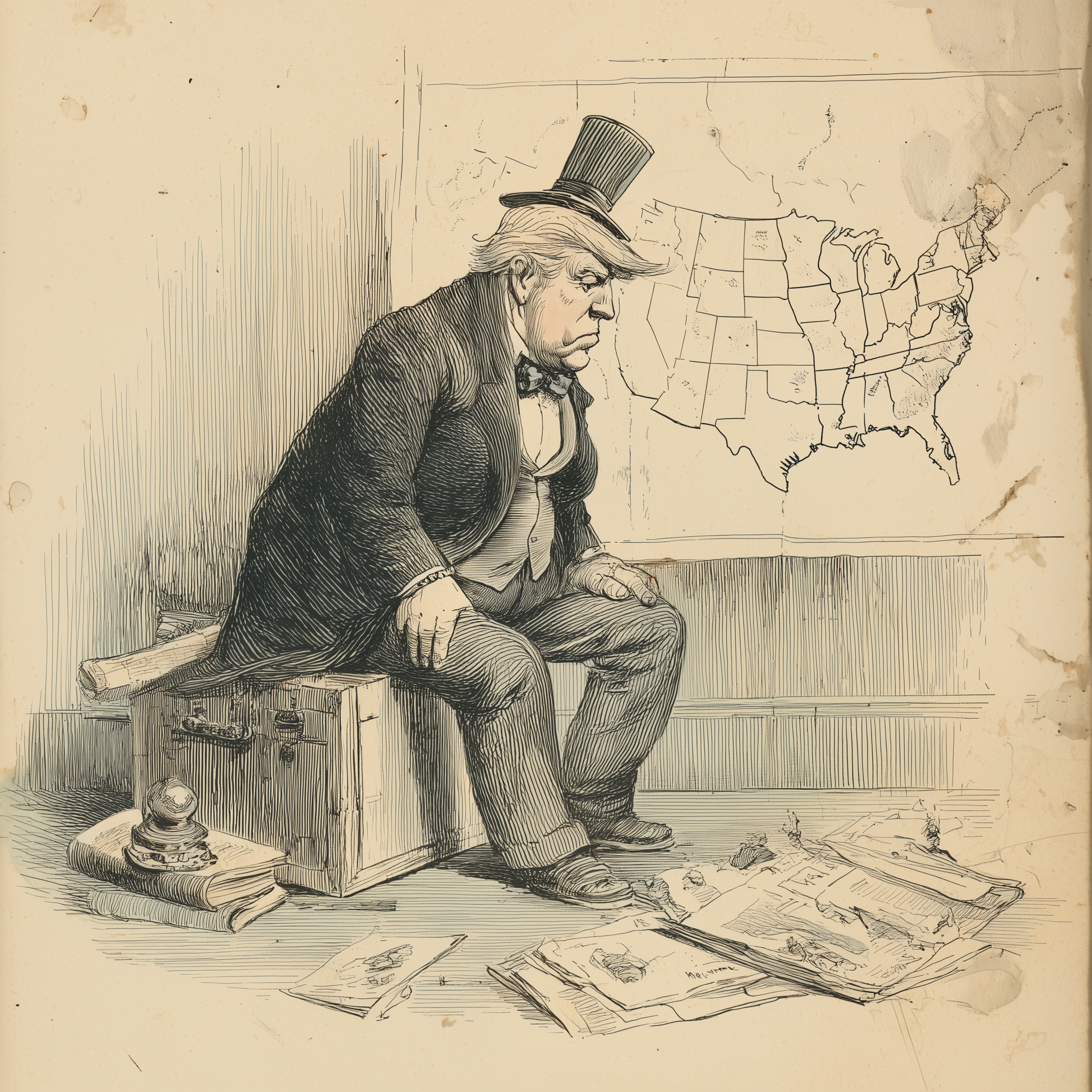
That laugh in Ames didn't stay in Ames.
It echoed through the 2016 primaries, where Republican rivals kept waiting for Trump to collapse and kept not understanding why he didn't. It echoed through the general election, where "Access Hollywood" was supposed to end him and didn't, where every scandal that should have been fatal became instead a proof of concept: his people didn't leave. It echoed through four years of a first term, an insurrection, an indictment, and a second term. It's still echoing now.
If you read "The Laugh," you understand the psychology—the contempt for weakness, the moral universe where losing is a sin and winning justifies itself. But psychology alone doesn't explain how a roomful of Iowans laughing at a POW becomes a governing coalition that controls the executive branch, dominates the judiciary, and is systematically dismantling the administrative state.
For that, you need to see the structure.
What follows is a map. It's not comprehensive—no single document could be—but it's detailed enough to be useful. The coalition that brought Trump to power and sustains him there is not a monolith. It's three interlocking systems, each with different motivations, different internal logic, and different vulnerabilities. Understanding how they fit together is the first step toward knowing where to push.
The Three Tiers
Tier One: The President. A man with a hole where other people keep their conscience. His need for dominance, adulation, and impunity is not a political strategy—it's a pathology that treats every institutional constraint as a wound and every act of accountability as an unforgivable betrayal. He would burn the republic to avoid admitting he lost. He embraces white Christian nationalist and America First agendas not because he believes in them—it's not clear he believes in anything beyond his own reflection—but because they deliver a base that will forgive anything and a permission structure for destroying anyone who tells him no.
Tier Two: The Apparatus. A network of party officials, movement lawyers, think tanks, donors, and media outlets building the infrastructure for permanent minority rule. They dress it up in constitutional theory and religious liberty, but the through-line is clear enough: a country where the people on top stay on top, look like them, and democracy can't threaten that arrangement. They needed a frontman shameless enough to say the quiet parts aloud. Trump needed machinery to convert rallies into governance. The alliance holds because both sides are getting what they want.
Tier Three: The Base. A coalition held together by the feeling that their country is being stolen, by immigrants, by cities, by people who don't look like them or pray like them or respect the way things used to be. Some of them are Christian nationalists who believe God ordained this nation for people like them. Some of them worship hierarchy itself—winners on top, losers knowing their place. Some are just tired and scared and willing to follow anyone who promises to hit back. They're not identical, and the differences matter.
Tier One: The President
Start with what he is, not what he says he is.
Donald Trump is not a conservative. He has no fixed ideology, no principled commitments, no policy convictions that can't be abandoned by next week. What he has is a hunger, and the hunger is pathological: dominance, adulation, and the destruction of anyone who refuses to provide those to him. Scholars who study authoritarianism have a term for the pattern. They call it malignant narcissism: grandiosity fused with paranoia, a missing capacity for empathy, and a willingness to harm others without hesitation or remorse.¹ (AKA the ‘dark triad’).
This is not name-calling. It's clinical. And it matters because it explains what otherwise looks like chaos.
Why does Trump attack judges who rule against him, election officials who certified his loss, generals who wouldn't follow unlawful orders, and allies who offered anything less than total submission? Not because he disagrees with them. Because their independence is intolerable. Every constraint on his will registers as a narcissistic injury, and every injury must be avenged. The physical cruelty is not incidental to the politics. It is the politics.
He has said so himself, in terms plain enough that we should stop pretending not to understand. "Article II allows me to do whatever I want as president."² That's not constitutional theory. It's a declaration of intent. The presidency, in his view, is not an office with boundaries. It's a throne.
His first term tested how much the system would tolerate. He pressured Ukraine to manufacture dirt on a political opponent and got impeached for it, then acquitted by a party that had already learned to kneel.³ He surrounded himself with loyalists, fired inspectors general, pardoned cronies, and floated the idea of pardoning himself. When he lost in 2020, he tried to overturn the election, culminating in a mob storming the Capitol while he watched on television and resisted calls to intervene.⁴
The physical destruction that day was significant. The deeper damage was to the norm that losing candidates accept the results. Trump didn't just refuse to concede. He convinced tens of millions of Americans that the election had been stolen, a lie he maintains to this day and that has become a loyalty test for Republican candidates nationwide.
His second term has dispensed with the guardrails.
The administration now governs in close alignment with Project 2025, a Heritage Foundation blueprint produced by over 100 conservative organizations to, in their words, "institutionalize Trumpism."⁵ The agenda is not hidden. It includes:
Concentrating presidential power by gutting the independence of federal agencies, purging career civil servants, and replacing them with pre-vetted loyalists who will not say no.⁶
Dismantling regulatory enforcement of environmental, consumer, and civil rights protections, while withdrawing from international climate agreements and multilateral institutions that constrain unilateral American action.⁷
Imposing a white Christian nationalist social order through federal policy: rolling back LGBTQ+ protections, eliminating reproductive rights, ending diversity programs, and enshrining "traditional family" hierarchies as explicit government goals.⁸
Executing mass deportations and slashing both illegal and legal immigration, using rhetoric ("invasion," "poisoning the blood") drawn directly from white nationalist literature.⁹
Trump did not design this agenda. He doesn't have the patience or the interest. But he has embraced it because it serves his purpose. Every expansion of executive power makes it harder to hold him accountable. Every purge of independent officials removes someone who might say no. Every attack on the "deep state" justifies replacing professional expertise with personal loyalty.
The cruelty is the point, yes. But it's also the method. Norm violation is not a bug in Trump's politics. It’s a feature. Each unpunished transgression raises the threshold for the next one. Each outrage that his base forgives becomes proof that they will forgive anything. The physical performance of dominance (the rallies, the insults, the refusal to apologize, ever) is how he maintains the bond with his followers. He shows them that he will never submit, and they love him for it, because submission is what they fear most in themselves.
This is what we're dealing with at the top. Not a normal president with abnormal policies. A man who experiences democratic accountability as persecution and who will use every tool available to ensure he never has to feel that way again.Tier Two: The Apparatus
Trump is the face. But faces need bodies.
Behind him stands a machinery decades in the making: a network of think tanks, legal organizations, donor consortiums, media outlets, and party operatives who had been preparing for this moment long before Trump descended his golden escalator. They didn't build it specifically for him. They built it for whoever would be willing to use it. He just happened to be the one shameless enough to say yes to everything.
Understanding this machinery requires abandoning the idea that Trump "took over" the Republican Party. The relationship is more symbiotic than that. The party's institutional players had spent years constructing the tools for minority rule: gerrymandering so aggressive that state legislatures stay red even when more voters choose Democrats, voter suppression laws dressed up as "election integrity," a judicial pipeline designed to stack the federal bench with ideologues vetted for loyalty to the project.¹⁰ What they lacked was a performer who could keep the base inflamed enough to tolerate the program.
Trump provided the heat. The apparatus provided the structure. Neither controls the other. They need each other, and they know it.
The Policy Engine
The Heritage Foundation has operated in Washington since 1973, but Project 2025 represents something new: a government-in-waiting, complete with personnel databases, draft executive orders, and detailed plans for every agency.¹¹ Over 100 conservative organizations contributed. The mandate was explicit: be ready on day one to dismantle the administrative state and replace it with something obedient.
This isn't ideology in the abstract. It's operational planning. The project identified roughly 50,000 federal positions that could be filled with loyalists.¹² It produced a 900-page playbook covering everything from gutting the EPA to restructuring the Department of Justice to eliminate prosecutorial independence.¹³ When Trump's second term began, the playbook became policy. The administration has moved faster and with more coordination than the first term precisely because the homework had been done.
The Federalist Society performs a similar function for the judiciary. For forty years it has cultivated, vetted, and promoted conservative lawyers, creating a pipeline that now dominates the federal bench and the Supreme Court.¹⁴ Trump's three Supreme Court appointments were Federalist Society products. So were most of his circuit court judges. This was not Trump's accomplishment; he simply signed what was handed to him. The society had the lists ready.
Behind both sits a donor class that funds the operation: fossil fuel executives who want deregulation, private equity barons who want tax advantages, tech billionaires who want antitrust enforcers to look the other way. Their motivations are largely transactional. They don't always share the base’s cultural grievances, but they'll finance those grievances in exchange for the policies they want.¹⁵ The coalition holds because everyone is getting paid.
The Ideological Core
This isn't just about money. The apparatus also runs on belief, and the belief that matters most is white Christian nationalism.
Let's be precise about the term. Christian nationalism is not Christianity. It's not going to church or reading the Bible or trying to live by the Sermon on the Mount. It's a political theology: the belief that America was founded as a Christian nation, that it was meant to be governed according to Christian (specifically Protestant) principles, and that "real" Americans are those who share this identity.¹⁶ Everyone else is a guest at best, an invader at worst.
Survey data lets us measure this with some precision. PRRI's 2024 American Values Atlas found that roughly 30% of Americans qualify as Christian nationalism "Adherents" or "Sympathizers." But the distribution is not even: a majority of Republicans fall into these categories, and at the state level, support for Christian nationalism correlates almost perfectly with support for Trump.¹⁷
What do Christian nationalists believe? The research is consistent.¹⁸ They are far more likely than other Americans to:
Support political violence "to save the country."
Endorse the idea that immigrants are "invading" and "poisoning the blood" of the nation.
Deny that systemic racism exists while holding demonstrably pro-white attitudes.
Support patriarchal gender roles and oppose LGBTQ+ rights.
Believe that God has chosen Trump for this historical moment.
That last item deserves emphasis. A majority of Christian nationalist adherents say, in surveys, that God ordained Trump's 2024 victory.¹⁹ This is not a metaphor to them. It is literal divine intervention. And if you believe your leader was placed in power by God, then constraints on his power start to look like rebellion against God's will. Democracy becomes an obstacle, not a value.
This is the ideological fuel in the tank. The apparatus runs on it.
The Media Ecosystem
Ideas need distribution. That's where the right-wing media system comes in.
Fox News, OANN, Newsmax, talk radio, an archipelago of hyperpartisan websites, and social media influencers with audiences larger than most newspapers: together they constitute something that functions less like a news operation and more like a closed epistemic universe.²⁰ Research on conservative media consumption finds that it operates almost like a quasi-religious community, with its own authorities, its own rituals, and aggressive boundary-policing against outside information.²¹
The echo chamber is not a metaphor. Studies consistently show that right-wing news audiences are more informationally siloed than their left-wing counterparts, and that exposure to this media measurably changes attitudes: increasing skepticism of climate science, hostility to public health measures, and support for Republican candidates and positions.²² The causation runs both directions. People self-select into congenial media, and the media then shapes what they believe.
The relationship between this ecosystem and the party is symbiotic. Politicians use the media to reach the base; the media use access to politicians to maintain credibility and audience. When Trump says something outrageous, the right-wing media reframes it as either justified or misrepresented by the mainstream press. When the mainstream press fact-checks Trump, the right-wing media frames the fact-check as persecution. Every external criticism becomes evidence of the conspiracy against "us."²³
In Trump's second term, this loop has tightened further. Far-right outlets trade access and sycophancy for ever more extreme framing; Republican officials then cite those outlets to justify policy; the administration uses the resulting narratives as pretext for executive action.²⁴ The press that might provide friction has been systematically delegitimized in the eyes of the base. For roughly a third of the country, mainstream journalism is not merely biased but actively malicious, an enemy to be defeated rather than a watchdog to be tolerated.
How It Holds Together
The apparatus is not a conspiracy in the sense of a secret cabal coordinating in hidden rooms. It's a coalition of interests that have learned to move in the same direction. Donors want deregulation and tax cuts. Legal activists want ideologically captured courts. Policy shops want to dismantle the administrative state. Media outlets want audience and access. Christian nationalists want a government that enforces their vision of moral order.
None of these groups dictates to the others. What they share is a common enemy (pluralistic democracy that might empower the wrong people) and a common vehicle (the Republican Party, remade in Trump's image). The alignment is emergent, rather than designed. But it is no less effective for being decentralized.
Trump sits atop this structure not because he built it, but because he was willing to front for it. He gets the adulation, the immunity, the revenge. They get the judges, the deregulation, the deportations, the restoration of a social order where their people stay on top. So far, everyone is getting what they wanted. That's why it holds.
Tier Three: The Base
Now we get to the people in the room. The ones who laughed.
It would be convenient if they were all the same. If you could draw a single profile (poor, rural, uneducated, racist) and be done with it. Convenient, but wrong. The coalition that fills Trump's rallies and delivers his margins is not a monolith. It's a patchwork of different groups with different motivations, held together not by a shared demographic profile but by a shared set of feelings. Understanding what those groups are, and where they overlap, is essential if you want to know which parts of this coalition might fracture and which parts are bedrock.
Let's start with who they actually are, demographically, before we get to what drives them.
The Demographics
The data here comes from large-scale surveys: the American National Election Studies, PRRI's American Values Atlas, and dedicated panel studies of MAGA supporters conducted since 2016.²⁵ The picture they paint is more complicated than the stereotypes suggest.
MAGA supporters are disproportionately white, older, Christian, and male. But "disproportionately" is not "exclusively." Trump's 2024 coalition included meaningful gains among Latino voters (particularly evangelical Protestants), some Black voters, and younger men across racial groups.²⁶ The realignment is ongoing.
They are not uniformly poor or uneducated. Roughly half of strong MAGA supporters report household incomes above $50,000. About one-third have at least a college degree.²⁷ The "left behind" narrative captures something real, but it misses the suburban professionals, the small business owners, the retirees with paid-off houses who vote MAGA too.
They are geographically broad. Yes, rural America is Trump country. But MAGA supporters live in every state, including substantial numbers in suburban and urban areas.²⁸ You cannot quarantine this coalition to flyover country. It's in your neighborhood, your office, your family.
The class story is real but indirect. White working-class voters (defined as white adults without a college degree) are a pillar of Trump's support. But they are not the only pillar, and economic hardship alone does not predict who among them votes Trump. The white working-class voters most drawn to Trump are not necessarily the poorest. They are the ones who feel they are losing ground relative to where they expected to be, and relative to groups they believe are cutting in line.²⁹
That sense of relative loss matters more than absolute deprivation. It's not "I have nothing." It's "I have less than I should, and someone else is getting what's mine."
The Four Motivational Clusters
Demographics tell you who's in the room. They don't tell you why. For that, you need to look at psychology and belief. And when you do, you find not one MAGA type but several, overlapping like circles in a Venn diagram.
One: The Christian Nationalists
We've already met them in Tier Two, but they belong here too, because they're not just ideologues in think tanks. They're a mass constituency.
These are the voters who believe America is and should be a Christian nation in a substantive sense: not just culturally influenced by Christianity, but governed according to Christian principles, with Christians (a particular kind of Christian) as its rightful leaders.³⁰ They see the last several decades as a long theft. Secular elites, multicultural activists, immigrants who don't share their faith: these forces have stolen the country their grandparents built. Trump's rise is, to them, a restoration. A majority say God put him in power.³¹
What follows from this belief is permission. If your leader is divinely ordained, his rule-breaking isn't corruption; it's holy defiance. If your enemies are enemies of God's plan, then defeating them justifies measures that would otherwise be unthinkable. This group is more likely than other Americans to endorse political violence "to save the country."³² Not because they're inherently violent, but because the theological stakes make violence imaginable.
Two: The Hierarchy Worshippers
This cluster cuts across religious lines. What defines them is not faith but a particular orientation toward power.
Psychologists measure this with two scales: Right-Wing Authoritarianism (RWA) and Social Dominance Orientation (SDO).³³ High-RWA individuals value submission to strong leaders, aggression toward out-groups, and strict social conformity. High-SDO individuals believe the world is and should be a hierarchy, with dominant groups on top and subordinate groups knowing their place. Both scales predict Trump support more reliably than income, education, or region.³⁴
These are the voters for whom the cruelty is not an unfortunate side effect but a positive good. They want a leader who dominates, who punishes weakness, who makes the right people suffer. When Trump mocks a disabled reporter or a dead soldier's family or a sexual assault accuser, they don't wince. They feel satisfaction. Finally, someone who doesn't apologize. Finally, someone who treats the losers the way losers deserve to be treated.
This is where the hatred of weakness lives. High-SDO individuals exhibit measurable contempt for people they perceive as low-status: the poor, the disabled, immigrants, anyone who can be framed as a "taker" rather than a "maker."³⁵ Their politics is not about policy. It's about establishing and enforcing a pecking order. Trump speaks directly to this desire every time he sneers at someone, and they love him for it.
Three: The Dispossessed
Here's where the sympathy belongs, even if it's complicated.
A significant portion of Trump's base consists of white working- and middle-class voters who have experienced, or fear they are about to experience, a genuine loss of status and security. Their towns are hollowing out. The jobs that let their fathers support a family are gone or going. The drugs came in and took their kids. The culture moved on and left them behind, and then mocked them for not keeping up.
These voters are not imagining things. The economic transformation of the past forty years has been brutal to people without college degrees, without inherited wealth, without the luck to live in the right zip code. Real wages stagnated. Union power collapsed. The social contract that promised you could work hard and do okay dissolved, and nothing replaced it except debt and despair.³⁶
But here's what happened to that pain. It got captured.
Instead of a politics that addressed the material sources of their suffering (capital flight, wage suppression, the slow strangulation of public investment in the places they live) they got a politics that told them their enemies were cultural: immigrants taking their jobs, feminists disrespecting their manhood, Black and brown people cutting in line for benefits that should have gone to them.³⁷ The con is as old as America. Convince the white working class that their interests align with the white ruling class, and both can stay in power.
Trump is the latest and loudest version of this con. He told them their pain was real (it is) and that he knew who to blame (he lied). The immigrants. The elites. The deep state. The media. Anyone but the actual structures that hollowed out their communities: the private equity firms that loaded companies with debt and stripped them for parts, the shareholders who demanded layoffs to juice quarterly earnings, the politicians of both parties who told them free trade would lift all boats while knowing full well some boats would sink.
These voters are victims. They are also, now, instruments of cruelty toward people even more vulnerable than themselves. Both things are true. Holding them together without excusing anything is the only honest position.
Four: The Partisans and the Transactional
Finally, there's a group that doesn't fit the ideological profiles but shows up anyway.
Some are simply partisan Republicans who would vote for any GOP nominee because that's what they've always done. Party identification is a powerful drug. It shapes perception, memory, and moral judgment. Once you're in the tribe, the tribe's leader becomes your leader, and loyalty kicks in.³⁸
Others are transactional: they dislike Trump's style, maybe even his character, but they want the judges, the tax cuts, the deregulation, the abortion restrictions. They hold their noses and vote because the alternative (a Democratic administration) is worse in their calculus. These voters often describe themselves as reluctant Trump supporters. They wish the party had nominated someone else. But when the lever comes, they pull it.
This group matters strategically because they are the most movable. They are not true believers. They are not in love. They are making a deal, and deals can fall apart if the costs rise high enough or the benefits stop arriving. Economic mismanagement, foreign policy catastrophe, personal scandal that even Fox can't spin: these are the things that might peel away the transactional voters while the core stays welded in place.
What Holds Them Together
Four clusters, different motivations, but they vote as a bloc. How?
The answer is not ideological coherence. It's emotional resonance.
What these groups share is not a policy agenda but a feeling: that something has been taken from them, that someone else is to blame, and that Trump will hurt the people who deserve to be hurt. The Christian nationalist feels the country was stolen by secular elites. The hierarchy worshipper feels the natural order is being inverted by people who should know their place. The dispossessed worker feels the economy was rigged against him by forces he can't name. The partisan feels the other party is an existential threat to everything he values.
Different diagnoses, different villains, but the same emotional structure: loss, blame, revenge.
Trump is the point where all these frequencies converge. He tells the Christian nationalist that he'll restore God's country. He tells the hierarchy worshipper that he'll crush the weak and reward the strong. He tells the dispossessed worker that he'll bring back the jobs and punish the people who shipped them overseas. He tells the partisan that he'll destroy the Democrats once and for all.
He doesn't have to mean any of it. He just has to say it with conviction, over and over, while never apologizing and never backing down. The message is less important than the posture. He fights. He doesn't submit. He makes the right people angry. For a coalition bonded by the feeling that they've been humiliated and dismissed, that posture is everything.
The laugh in Ames was the sound of these frequencies locking in. It's been echoing ever since.
What Now
If you've read this far, you understand something that most political commentary refuses to say plainly: this is not a normal political coalition that will be defeated by normal political means.
You are not facing a party that disagrees with you about tax policy or healthcare or the proper scope of federal regulation. You are facing an interlocking system designed to maintain power regardless of what the majority wants. A leader who treats accountability as persecution. An apparatus that has spent decades engineering the rules to guarantee its outcomes. A base that has been taught to see compromise as betrayal and pluralism as extinction.
Your disappointment is justified. Your frustration at people who keep saying "this is not normal" while treating it as normal, who keep waiting for the fever to break, who keep believing that one more election or one more scandal will restore the world you thought you lived in: that frustration is a sane response to an insane situation.
It's not going to snap back. There is no autopilot that returns America to democratic norms if you just wait long enough. The forces that produced Trump were building for decades before he arrived and will outlast him when he's gone. He is a symptom and an accelerant, but he is not the disease.
Nothing Emerges in a Vacuum
This is perhaps the most important thing to understand, and the thing most often missed.
The laugh in Ames didn't come from nowhere. It came from forty years of wage stagnation and fifty years of the Southern Strategy. It came from a media ecosystem that learned to monetize rage and a donor class that learned to channel that rage toward its own ends. It came from a religious movement that fused American identity with a particular kind of Christianity and convinced its followers that losing political power meant losing their souls. It came from a meritocracy myth that told struggling people their struggles were their own fault, until the shame curdled into contempt for anyone they could push below them.
Trump didn't create any of this. He just walked into a room full of gasoline and lit a match.
The apparatus didn't create Trump. They built a machine and waited for someone willing to drive it off the cliff.
The base didn't create the apparatus. They were cultivated, harvested, and pointed at targets by people who needed their anger but had no intention of addressing its actual sources.
Each tier enables the others. Each tier needs the others. And each tier, in isolation, is weaker than it appears.
The leader without the machinery is just a man yelling at rallies. The machinery without the base has no votes. The base without leadership and infrastructure is just free-floating resentment, powerful but directionless.
The system is strong because it is interlocking. But interlocking systems have joints, and joints can be stressed.
What Can Shift
Not everything is movable. Let's be honest about that.
The core Christian nationalists, the high-SDO hierarchy worshippers, the true believers who see Trump as God's instrument: these are not people you will persuade. Their worldview is not a misunderstanding to be corrected but an identity to be defended. Every fact that contradicts their beliefs becomes evidence of the conspiracy against them. They are, for practical purposes, lost to democratic politics. The goal with them is not conversion but containment: outvote them, out-organize them, constrain the damage they can do.
The apparatus is even harder to move because it is not driven by emotion but by interest. The donors, the lawyers, the think-tankers: they are getting what they paid for. Courts packed with ideologues. Regulations gutted. Tax burdens shifted downward. They will not abandon the project because it offends democratic sensibilities. They will abandon it only if it stops delivering, or if the costs (legal, reputational, financial) become too high. Accountability matters here. Prosecutions matter. Making corruption expensive matters.
But the base is not monolithic, and this is where possibility lives.
The dispossessed, the economically anxious, the people whose pain is real even if it's been weaponized: they are not permanently wedded to this coalition. They joined because someone spoke to their suffering and named an enemy. They can be reached by a politics that takes their suffering seriously and names the actual enemy: not immigrants, not feminists, not Black people demanding justice, but the economic structures that strip-mined their communities and the political class that let it happen.
This is not about finding nicer ways to say the same things. It is about actually delivering: material improvements in people's lives that they can see and feel. Healthcare that doesn't bankrupt them. Jobs that pay enough to live on. Towns that aren't hollowed out by capital flight. Dignity that doesn't depend on standing on someone else's neck.
The transactional Republicans, the reluctant Trump voters, the people who tell pollsters they wish the party had nominated someone else: they are calculating a cost-benefit ratio. Right now, the benefits outweigh the costs. But ratios shift. Economic chaos, military disaster, corruption too blatant to ignore, the slow accumulation of exhaustion with the constant drama: these can flip the math. Not for everyone, but for enough.
And the echo chamber, while powerful, is not total. Only a minority of Americans live in fully sealed information environments. The rest are reachable, if you know how to reach them. Local messengers matter. People trust their neighbors, their pastors, their coworkers more than they trust cable news. The information that breaks through is information delivered by someone inside their world, not someone lecturing from outside it.
What Comes Next
This is a map, not a manual. Knowing the anatomy of the threat is the first step. Knowing what to do about it is the next.
Two questions remain, and they will be the subject of what follows.
First: what does it actually take to move the movable? Not in theory, but in practice. What messages work? What messengers? What does it look like to speak to legitimate grievance without capitulating to the scapegoating that has captured it? How do you fight for people who have been convinced you're their enemy?
Second: what does it take to hold the line while the long work happens? The authoritarian project is not waiting. Every day brings new executive orders, new purges, new assaults on the institutions that might constrain power. Defense is not optional. How do you protect what remains of democratic infrastructure while building something better? How do you resist without becoming what you're resisting?
These are not rhetorical questions. They have answers, or at least partial answers, drawn from history and research and the hard-won knowledge of people who have fought these battles before.
The system you're facing is strong. But it is not invincible. It has joints, and joints can be stressed. It has dependencies, and dependencies can be disrupted. It has contradictions, and contradictions can be exploited.
The laugh is still echoing. But echoes fade. What comes next depends on whether enough people understand what they're hearing and decide to answer it with something louder.
That's what I will take up next.
Atma
January 2026
Endnotes
For clinical and political applications of malignant narcissism to Trump, see John Gartner et al., Rocket Man: Nuclear Madness and the Mind of Donald Trump (Chichester: John Wiley & Sons, 2018); and Bandy X. Lee, ed., The Dangerous Case of Donald Trump: 27 Psychiatrists and Mental Health Experts Assess a President (New York: St. Martin's Press, 2017).
Trump made this claim in remarks to reporters on July 23, 2019. Transcript available through C-SPAN and contemporaneous news coverage.
For the Ukraine pressure campaign and first impeachment, see U.S. House of Representatives, "Impeachment of Donald John Trump, President of the United States," H. Res. 755, 116th Congress (2019).
The January 6th Committee documented Trump's actions and inaction during the Capitol attack. See U.S. House Select Committee to Investigate the January 6th Attack on the United States Capitol, Final Report (Washington, DC: Government Publishing Office, 2022).
Heritage Foundation, Mandate for Leadership: The Conservative Promise (Washington, DC: Heritage Foundation, 2023). This is the primary Project 2025 policy document.
On civil service restructuring and Schedule F, see Donald Moynihan, "What Is Schedule F, and Why Does It Matter?" Brookings Institution, January 2025.
On environmental and regulatory rollbacks in the second term, see Lisa Friedman, "Trump's Environmental Rollbacks, Round Two," New York Times, February 2025; and "Trump 2.0 Enters 2026 in Full Force," Global Affairs, January 2026.
On LGBTQ+ and reproductive rights rollbacks aligned with Project 2025, see "How Project 2025 Became the Blueprint for Donald Trump's Second Term," The Conversation, January 2025.
Trump used "poisoning the blood" language at rallies in late 2023 and throughout 2024. For analysis of its white nationalist origins, see "Trump Administration's Posts Echo Rhetoric Linked to Extremist Groups," PBS NewsHour, March 2025.
On the long-term project of structural Republican advantage through gerrymandering and voter suppression, see David Daley, Ratf**ked: Why Your Vote Doesn't Count (New York: Liveright, 2016); and Ari Berman, Give Us the Ballot: The Modern Struggle for Voting Rights in America (New York: Farrar, Straus and Giroux, 2015).
Heritage Foundation, Mandate for Leadership, 2023.
On the personnel database and 50,000 positions, see Jonathan Swan, "Trump Allies Prepare to Infuse 'Next Administration' with MAGA Loyalists," Axios, July 2023.
The 900-page playbook is the Mandate for Leadership document itself, supplemented by agency-specific transition documents prepared by Project 2025 working groups.
On the Federalist Society's role in judicial selection, see Amanda Hollis-Brusky, Ideas with Consequences: The Federalist Society and the Conservative Counterrevolution (New York: Oxford University Press, 2015).
On donor networks funding conservative infrastructure, see Jane Mayer, Dark Money: The Hidden History of the Billionaires Behind the Rise of the Radical Right (New York: Doubleday, 2016).
For the scholarly definition and measurement of Christian nationalism, see Andrew L. Whitehead and Samuel L. Perry, Taking America Back for God: Christian Nationalism in the United States (New York: Oxford University Press, 2020).
Public Religion Research Institute, "Christian Nationalism Across All 50 States: Insights from PRRI's 2024 American Values Atlas," May 2025.
PRRI, "Christian Nationalism Across All 50 States," 2025; see also Philip Gorski and Samuel Perry, The Flag and the Cross: White Christian Nationalism and the Threat to American Democracy (New York: Oxford University Press, 2022).
PRRI, "Christian Nationalism Across All 50 States," 2025. The survey found that a majority of Christian nationalism "Adherents" believe God played a role in Trump's 2024 victory.
On the structure of right-wing media, see Yochai Benkler, Robert Faris, and Hal Roberts, Network Propaganda: Manipulation, Disinformation, and Radicalization in American Politics (New York: Oxford University Press, 2018).
Megan Duncan, "Beyond Polarization: Right-Wing News as a Quasi-religious Phenomenon," Sociological Quarterly 66, no. 2 (2025).
On echo chamber effects and attitude change, see Matthew Gentzkow and Jesse M. Shapiro, "Ideological Segregation Online and Offline," Quarterly Journal of Economics 126, no. 4 (2011): 1799–1839; and Gary King, Benjamin Schneer, and Ariel White, "How the News Media Activate Public Expression and Influence National Agendas," Science 358, no. 6364 (2017): 776–780.
On the symbiotic relationship between Republican politicians and right-wing media, see Jackie Calmes, Dissent: The Radicalization of the Republican Party and Its Capture of the Court (New York: Twelve, 2021).
On the intensification of this dynamic in Trump's second term, see "In His Second Term, Trump Fuels a 'Machinery' of Misinformation," New York Times, March 2025.
American National Election Studies, 2016–2024; PRRI American Values Atlas, 2024; University of Washington MAGA Panel Study, 2021–2024.
Pew Research Center, "Behind Trump's 2024 Victory: Turnout, Voting Patterns and a More Racially and Ethnically Diverse Voter Coalition," June 2025.
University of Washington MAGA Panel Study, "Demographics and Group Affinities," 2024.
Pew Research Center, "Behind Trump's 2024 Victory," 2025.
On relative deprivation versus absolute deprivation, see Diana C. Mutz, "Status Threat, Not Economic Hardship, Explains the 2016 Presidential Vote," Proceedings of the National Academy of Sciences 115, no. 19 (2018): E4330–E4339.
Whitehead and Perry, Taking America Back for God, 2020.
PRRI, "Christian Nationalism Across All 50 States," 2025.
PRRI, "Survey: Four in Ten Americans Are Susceptible to Authoritarianism but Most Still Reject Political Violence," 2024.
On RWA, see Bob Altemeyer, The Authoritarians (Winnipeg: self-published, 2006). On SDO, see Jim Sidanius and Felicia Pratto, Social Dominance: An Intergroup Theory of Social Hierarchy and Oppression (New York: Cambridge University Press, 1999).
Thomas F. Pettigrew, "Social Psychological Perspectives on Trump Supporters," Journal of Social and Political Psychology 5, no. 1 (2017): 107–116; see also Monmouth University Polling Institute, "Authoritarianism Among Trump Voters," January 2021.
Sidanius and Pratto, Social Dominance, 1999.
On the economic transformation and its effects on working-class communities, see Anne Case and Angus Deaton, Deaths of Despair and the Future of Capitalism (Princeton: Princeton University Press, 2020).
On the historical pattern of redirecting working-class grievance toward racial scapegoats, see Ian Haney López, Dog Whistle Politics: How Coded Racial Appeals Have Reinvented Racism and Wrecked the Middle Class (New York: Oxford University Press, 2014).
On partisan identity and motivated reasoning, see Lilliana Mason, Uncivil Agreement: How Politics Became Our Identity (Chicago: University of Chicago Press, 2018).