The Courage to Be Wrong
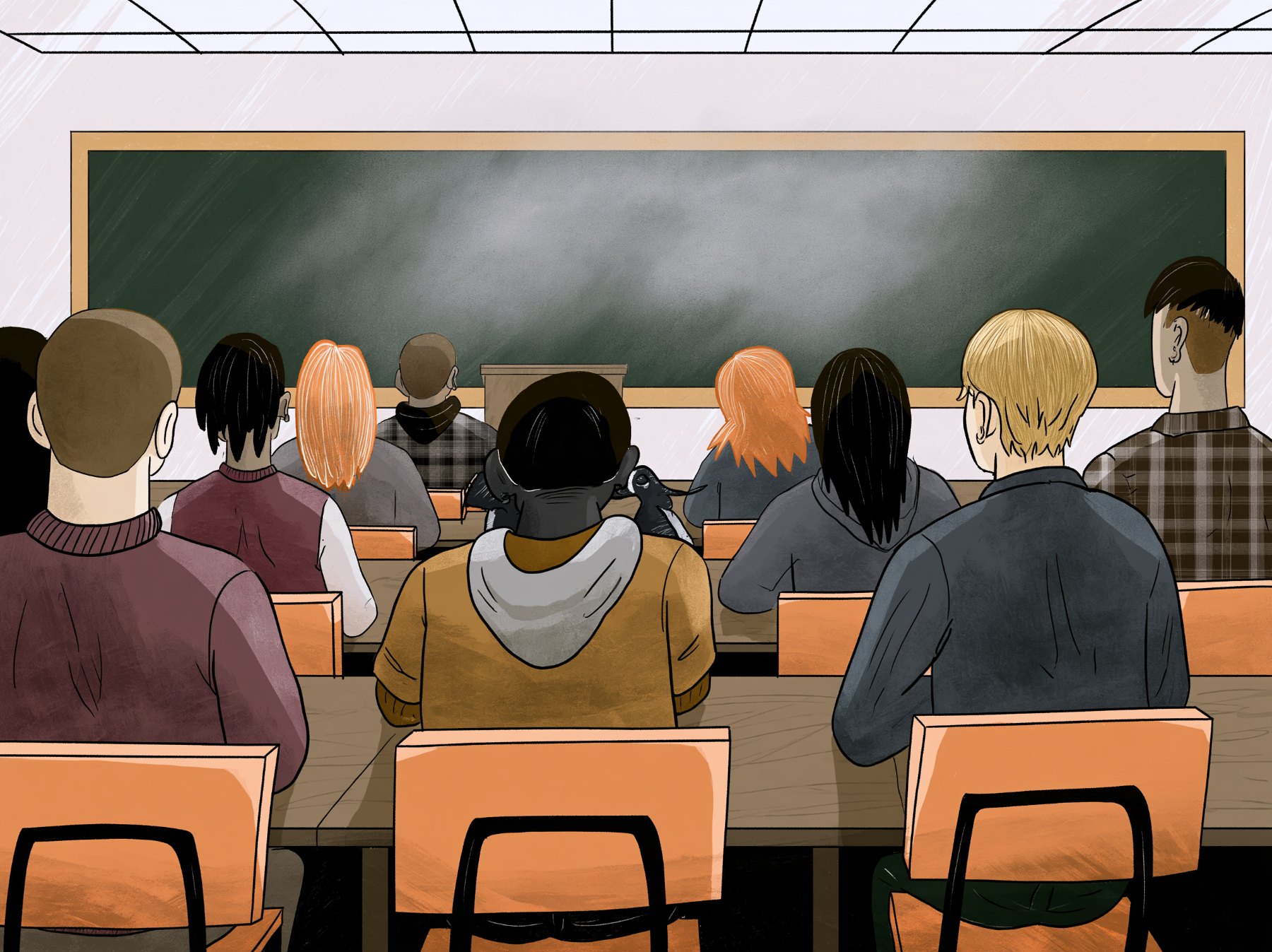
What Schools Must Risk to Teach Critical Thinking
Maria Torres is fifteen years old, and at 2:17 on a Thursday afternoon, she is having a very bad time.
She’s standing at the whiteboard in Ms. Rivera’s ninth-grade civics class, defending a proposal to ban smartphones throughout the school day. The room smells faintly of dry-erase markers and somebody’s abandoned lunch. A fluorescent light buzzes overhead. Above the classroom clock, a crooked poster announces: THINK FOR YOURSELF.
Maria has prepared carefully. She has statistics about distraction, a newspaper article about declining attention spans, and three arguments written in neat blue ink.
Her opening statement was excellent.
Now Jalen, a boy in the second row, has raised his hand.
“You said the ban should apply to everybody, right?”
“Yes. Otherwise people will make excuses.”
“My mom works two jobs. Sometimes I have to pick up my little brother when her shift changes. If she texts me and I’m not allowed to answer, what am I supposed to do?”
“She could call the office.”
“They don’t always answer.”
Maria starts to explain that schools need rules, that exceptions become loopholes, that students should learn responsibility. All reasonable things to say. She’s halfway through her second sentence when she realizes she hasn’t answered him.
Someone in the back makes a noise. Not quite a laugh. Worse, actually. The small, satisfied sound teenagers make when somebody who usually has the answers suddenly doesn’t.
Maria looks at her notes.
She knows the research about distraction is real. She also knows Jalen’s problem is real. Worse still, she knows that five minutes earlier she described the ban as fair to everyone.
Ms. Rivera doesn’t rescue her.
“That’s a serious objection, Maria. Do you want to revise your proposal?”
Maria could say yes. She could also defend herself, attack Jalen’s example, or pretend she didn’t hear the question.
The room waits.
And here, in this rather unpleasant little moment, is the part of critical thinking our education system has been remarkably reluctant to teach.
The part that hurts.
The Mind Has a Bodyguard
We talk about critical thinking as though it were an intellectual skill, somewhere between algebra and reading comprehension. Teach students to identify assumptions, examine evidence, recognize fallacies, and construct arguments. Give them a rubric. Test them in June.
Useful, as far as it goes.
It doesn’t go nearly far enough.
The obstacle to clear thinking isn’t always ignorance. Often it’s the knowledge we already possess, the explanations we’ve grown attached to, and the identities we’ve built around being the sort of person who knows certain things.
Leon Festinger gave psychology a name for some of this discomfort in 1957: cognitive dissonance. When our beliefs, behavior, and new information collide, the resulting tension motivates us to restore some consistency. Changing our minds is one option. Finding reasons to dismiss the troublesome information is another.1
The second option is remarkably popular.
Consider the terrible efficiency of an intelligent person defending a bad idea. Give that person a contradiction and watch what happens. Suddenly they’re a lawyer. They discover exceptions, question definitions, challenge the witness, and demand a standard of proof they never applied to their original claim.
Hugo Mercier and Dan Sperber have argued that human reasoning has an important social and argumentative function. We produce reasons, evaluate other people’s arguments, and attempt to persuade one another. Under favorable conditions, this can make groups better at reasoning than isolated individuals. It also helps explain our remarkable talent for defending conclusions we’ve already reached.2
Intelligence doesn’t automatically solve this problem.
Sometimes it just supplies better ammunition.
Maria isn’t struggling because she’s stupid. She researched a subject, organized her evidence, and reached a defensible conclusion.
Now she must decide whether to defend that conclusion or investigate its weakness.
The decision has an emotional cost.
Nobody enjoys discovering that an argument they proudly delivered five minutes earlier has a serious hole in it. Especially with an audience. Especially at fifteen.
We want students to question their beliefs, but we rarely acknowledge what we’re asking them to risk.
Their confidence. Their standing among classmates. Sometimes the approval of parents, teachers, or friends whose opinions matter enormously.
An argument can be corrected in a sentence. A threatened identity is harder to repair.
An Unusually Obstinate Effort
I first encountered a phrase by William James when I was a young college student. He described metaphysics as “an unusually obstinate effort to think clearly.”3
I loved that sentence.
Still do.
It captured something I had been trying to understand about the mind: clear thinking takes effort. Often an absurd amount of effort. It demands persistence, curiosity, and a willingness to return to questions that refuse to behave.
That fascination eventually found its way into my work. I developed pitching and mindset curricula and built Startup Ecology, an online school for entrepreneurs. Teaching people to examine ideas, develop arguments, and question assumptions became part of what I did.
You’d think that would make being corrected a pleasant experience.
It doesn’t.
There’s an embarrassing difference between understanding why people defend their beliefs and recognizing the impulse in yourself.
I can explain motivated reasoning. I can admire a brilliant counterargument. I can tell you, with considerable enthusiasm, why intellectual humility matters.
And I can still find being corrected deeply irritating.
The irritation arrives before the careful thinking. Before the evidence has been weighed. Before I’ve decided whether the objection is any good.
My intellect has a perfectly respectable job to do: examine the criticism. My ego has another assignment: find something wrong with the person delivering it, preferably before they’ve finished speaking.
I know which one is more tempting.
And I know that winning the exchange would prove very little.
There is something faintly ridiculous about spending years studying how the mind protects its beliefs and then discovering that yours has been taking notes.
The useful question is what happens after that first defensive impulse.
Do I examine the objection with the same care I’d give evidence supporting my position? Or do I seize on its weakest phrase, congratulate myself on finding a flaw, and escape without learning anything?
I’ve become less interested in classifying complicated ideas as simply right or wrong. Some claims are plainly false. Evidence and logic still have authority. But serious questions often present competing explanations with different strengths, assumptions, and consequences.
The task is to rank ideas by their evidential merit, then remain willing to change the ranking.
That last requirement causes all the trouble.
The Hidden Curriculum of Certainty
John Dewey understood more than a century ago that reflective thought begins when something interrupts our settled understanding. Doubt creates the occasion for inquiry. We investigate because our existing explanation no longer does the job.4
Schools have never been particularly comfortable with this arrangement.
Not because teachers don’t care. Many care enormously, and some perform daily miracles with thirty students, inadequate resources, and lesson plans held together by caffeine and stubbornness.
The problem is structural.
Schools must distribute grades, measure progress, maintain order, meet standards, satisfy parents, and demonstrate results to people who often have little patience for complicated explanations.
Certainty fits neatly into that machinery.
A correct answer gets a checkmark. A completed assignment gets a grade. A standardized test produces a number that can be entered into a spreadsheet and compared with another number.
A student who says, “I believed this on Monday, found evidence against it on Wednesday, and now I’m less certain than I was before,” presents an awkward administrative problem.
What grade is that?
In the wrong classroom, it looks like regression.
In the right classroom, it might be the most important thing the student has done all semester.
None of this makes factual knowledge disposable. Quite the opposite. You cannot reason intelligently about history without knowing history, evaluate a medical claim without understanding the relevant science, or discuss public finance while remaining innocent of arithmetic.
Knowledge supplies the material.
Critical thinking determines what we do when that material refuses to support our preferred conclusion.
Yet we’ve built an enormous educational apparatus around displaying knowledge, with far less attention to what happens when knowledge becomes uncomfortable.
Then we put critical thinking in the mission statement.
Of course we do.
Critical thinking has become the educational equivalent of a luxury label sewn into a cheap jacket. The label costs nothing. The jacket is the same jacket.
Print the words on the brochure. Hang them over the entrance. Celebrate independent thought at graduation. Commission another poster with a soaring eagle and an inspirational quotation.
Then watch what happens when a student questions a rule, a teacher challenges an approved interpretation, or a librarian refuses to treat somebody’s outrage as a substitute for evidence.
Suddenly everybody’s very concerned about maintaining order.
A school that advertises independent thinking while punishing serious disagreement is selling obedience with better typography.
And the children notice. They notice when a question is praised in one classroom and punished in another. They notice which historical subjects make adults nervous, which conclusions earn approval, and which disagreements are treated as evidence of bad character.
They learn the curriculum.
Including the part nobody wrote down.
Who Controls the Questions?
Education is political even when nobody mentions an election.
Someone chooses the curriculum. Someone selects the textbook. Someone decides which historical events receive a chapter and which receive a paragraph.
Those decisions influence what students are invited to investigate, and what they learn to leave alone.
Noam Chomsky and Edward Herman examined how institutional incentives influence the information that reaches the public. Their work concerned mass media, but the underlying question belongs in education: who determines which explanations become prominent, respectable, or difficult to challenge?5
The mechanism doesn’t require a secret conspiracy.
A parent complaint. A displeased donor. An administrator’s performance review. An electoral calculation nobody mentions in public.
None of these has to ban a question outright. They only have to make asking it expensive.
The practical test is straightforward.
Can students question a school policy without being dismissed as troublemakers? Can teachers challenge administrative decisions without inviting retaliation? Will politicians defend their claims with evidence when the questions become inconvenient?
And will activists allow young people to examine propaganda that happens to advance a cause they support?
The standard must run in every direction.
There is a trap here, too. Students can mistake suspicion for sophistication.
Every institution is corrupt. Every expert is compromised. Every explanation conceals a sinister motive.
Nothing can be trusted.
Wonderful. Now nothing needs to be investigated.
That’s cynicism dressed in intellectual clothing.
A critical thinker knows that institutions have interests without assuming every institutional claim is false. Expertise deserves evaluation, not automatic obedience or automatic contempt. Competing explanations do not become equally credible simply because somebody believes them.
The objective is to discover which account survives examination.
Including when the strongest account is the one you didn’t want to believe.
The Wonderful Humiliation of Explaining Something
In 2002, psychologists Leonid Rozenblit and Frank Keil investigated a peculiar human tendency.
People were asked how well they understood familiar mechanical devices. Then they had to explain how those devices actually worked.
Their confidence suffered.
The researchers called this the illusion of explanatory depth: we routinely mistake familiarity with a thing for understanding its underlying mechanism.6
Try it.
You probably know what a zipper does. You’ve used hundreds of them. Explain precisely how the teeth engage, why they remain locked, and what causes them to separate when the slider moves in the opposite direction.
No gestures. No pointing to a zipper. Explain the mechanism.
Things get uncomfortable surprisingly quickly.
Now consider the explanations we carry around about inflation, homelessness, immigration, climate change, artificial intelligence, or the causes of a war.
Entire political identities are constructed from explanations that have never survived the intellectual equivalent of the zipper test.
And the psychologists weren’t finished.
In 2013, Philip Fernbach and his colleagues took this idea into politics. They asked people about complex public policies, then had them explain how those policies would actually produce the consequences they expected.
Something remarkable happened.
Participants became less confident in their understanding. In the original experiments, their political positions also became more moderate.
Here’s the interesting part: merely asking people to list reasons for their preferred policies did not produce the same result.7
Think about that.
We spend enormous amounts of time encouraging people to defend their opinions. The experiment suggested that asking them to explain how their preferred solutions actually work might be more revealing.
A magnificent finding.
Almost too magnificent.
In 2021, researchers tried to reproduce the political-moderation effect in three preregistered replication studies. They found that people still recognized gaps in their understanding, but their political positions did not reliably become more moderate. Other follow-up research found that the effect depended partly on the kinds of political questions being examined.8
So the tidy little psychological cure for political extremism turned out to be considerably less tidy.
Good.
A promising explanation met contradictory evidence. Researchers investigated. The original claim became more limited, more complicated, and more defensible.
Anyone writing about the courage to be wrong ought to find that rather beautiful.
And for educators, the lesson survives: make students explain what they think they understand. Then help them identify the missing steps.
A polished paragraph is easy to mistake for thought.
So is a confident presentation.
Sometimes the most valuable question a teacher can ask is brutally simple:
“Explain how that works.”
Then remain quiet.
No rescue. No humiliation. Just enough silence for the student to discover the distance between recognition and understanding.
That distance is where education happens.
Learning to Think in Contradictions
Return to Maria and the smartphone ban.
Her argument is sound in one respect: distraction interferes with learning, and schools have legitimate reasons to regulate devices.
Jalen’s objection is sound in another: a rule designed for the average student can impose unequal burdens on students whose circumstances don’t resemble the average.
Now what?
The usual debate format offers two teams and a winner.
One side gathers evidence for the ban. The other gathers evidence against it. Each selects its strongest talking points and attempts to embarrass the opposition.
The audience applauds. The judge decides.
Everybody goes home with the arguments they arrived with, only louder.
Dialectical thinking asks for something more difficult.
We examine the contradiction and look for the assumptions that produced it. We reconstruct each position strongly enough that its advocate would recognize it. Then we investigate whether the conflict reveals a missing variable, a false choice, an unequal distribution of costs, or a genuinely unavoidable tradeoff.
The real question may concern which smartphone uses interfere with learning, which serve legitimate needs, who bears the cost of restrictions, and whether the school has the resources to administer exceptions fairly.
The problem has changed.
It hasn’t disappeared.
Dialectical thought is sometimes reduced to a soothing formula in which two opposing views shake hands and produce a compromise.
The formula is comforting. It’s also wrong.
Some disagreements cannot be reconciled. Some compromises disguise who is paying the price. And splitting the difference between a well-supported claim and a falsehood produces a smaller falsehood.
The task is to locate the disagreement accurately, test the competing explanations, and determine what the evidence justifies.
Sometimes that produces a synthesis.
Sometimes it produces a decision.
Sometimes it produces a question nobody in the room can yet answer.
We should teach students to recognize all three as legitimate results of serious inquiry.
The Revision Loop
I’ve come to think of this process as the Revision Loop.
It begins with a sentence.
Write down what you believe, precisely enough that someone could disagree with it. Vagueness is a marvelous hiding place for bad reasoning.
Then locate the discomfort. Which objection makes you defensive? Which evidence are you tempted to dismiss before examining? Your reaction doesn’t establish that the objection is correct. It identifies where your thinking deserves attention.
Next, reconstruct the strongest opposing argument. No straw men. No convenient idiots. Make the case so well that someone holding the opposing position would recognize it as fair.
Now audit the evidence. Check its quality, its source, the assumptions connecting it to the claim, and the interests shaping its presentation.
Apply the same standards when the evidence favors you.
Then comes the part most schools neglect.
Write the revised sentence.
Not a reflection about how interesting the discussion was. Not a declaration that everyone has different opinions.
A sentence that shows exactly what changed.
Maria’s might become:
I still believe schools should restrict distracting smartphone use, but a universal ban is unfair unless students have a reliable way to manage genuine family responsibilities.
Better.
More defensible.
Still unfinished.
The final part of the loop concerns action. What would Maria now recommend? Which exceptions would she permit? How would the school verify them without humiliating students or forcing families to disclose private circumstances? What evidence would tell her whether the revised policy works?
When that evidence arrives, the loop begins again.
Revision makes the movement of thought visible.
And movement doesn’t always mean abandoning the original position. Sometimes a student examines an objection and discovers that the evidence still supports the original conclusion.
That’s fine.
The achievement lies in having tested the belief rather than protected it.
Teaching What We Claim to Value
The research offers some encouragement.
In a 2015 meta-analysis, Philip Abrami and colleagues found modest but positive gains from deliberate critical-thinking instruction, with dialogue and mentoring among the promising features.9
Reviewing 225 undergraduate STEM studies, Scott Freeman and colleagues found that active learning generally outperformed conventional lecturing.10
Neither finding justifies a classroom free-for-all.
Discussion isn’t rigorous merely because people are talking. A group project isn’t educational simply because everybody has been assigned a different color of marker.
The question is what intellectual work the students must perform.
Do they explain? Investigate? Compare? Test? Revise?
In a 2023 study, Sarah McGrew and Joel Breakstone worked with ninth-grade teachers to teach students how to investigate online information.
One lesson involved an article about caffeine.
The author had a PhD. The article cited scientific studies. The website looked credible, with all the familiar signals that encourage a reader to relax and accept what appears on the screen.
But the students were asked to investigate beyond the article itself.
They discovered that the organization behind the website had connections to food and beverage companies with a financial interest in the subject.
Interesting.
The article didn’t suddenly become false. A PhD didn’t suddenly become meaningless. And the cited studies didn’t evaporate because somebody followed the money.
The discovery changed the investigation.
Who produced this information? Why? What does the underlying research actually say? Has anything relevant been omitted?
In another lesson, students encountered an unfamiliar-looking website address. Judging by appearances alone, they could easily have dismissed it.
It belonged to a legitimate United Nations water initiative.
The same superficial approach could have produced opposite mistakes: trusting a source too readily because it looked authoritative, or rejecting a legitimate one because its appearance seemed suspicious.
The students practiced lateral reading, moving beyond a website to investigate what other sources could tell them about it. Their performance improved, although many evaluations remained difficult.11
I find that much more interesting than another inspirational poster about asking questions.
The teacher wasn’t merely telling students to be skeptical. The students were learning how to investigate credibility, and discovering that the answer wasn’t always the one their first impressions suggested.
Suspicion is the beginning of an investigation, not its conclusion.
Assessment should recognize the same discipline. A teacher ought to be able to examine a student’s initial position, the objections considered, the evidence evaluated, and the final reasoning.
A student who revises a claim for a sound reason has done valuable work.
So has the student who withstands a serious objection because the evidence supports holding firm.
Reward the quality of the reasoning.
The answer alone tells us too little.
And because thinking occurs in public, the classroom must establish one nonnegotiable condition.
Intellectual discomfort is necessary. Public humiliation is not.
Maria needs to survive an inadequate argument without becoming a spectacle. Jalen must be able to challenge a policy without disclosing more about his family than he chooses. Ms. Rivera must be free to question both of them.
The room should be demanding enough for ideas to fail and safe enough for students to survive the failure.
That’s harder than hanging a poster.
The Machine That Can Pretend to Understand
Artificial intelligence has made the problem impossible to ignore.
A student can now produce a persuasive essay, a scientific explanation, or an elegant policy argument without understanding much of what appears on the page.
The prose looks like competence.
Sometimes it is. Sometimes it’s counterfeit.
A 2025 experiment involving nearly a thousand high-school mathematics students found that access to an unrestricted GPT-4-based assistant improved performance during practice but left students performing worse on a later independent assessment than students who had worked without that assistance. A more carefully guided AI tutor largely avoided the damage.12
A student can look smarter with the machine and become less capable without it.
The question is no longer whether students should encounter AI. They already have. The question is which parts of the intellectual work we’re willing to hand over.
A machine that challenges a student’s explanation, demands evidence, and exposes assumptions can help the student think.
A machine that supplies every answer can help the student avoid thinking.
Our assessment systems have spent decades rewarding polished products.
Now the machines produce them on demand.
The zipper test has become considerably more important.
What Remains on the Page
Back in Ms. Rivera’s classroom, Maria is still standing at the whiteboard.
She hasn’t surrendered her position. She still thinks phones are a distraction, and she has evidence to support it.
But her original claim, the one about a universal ban being fair to everyone, no longer holds.
She returns to her seat with her notebook open.
Jalen is looking at his desk. The boy who made the noise in the back has lost interest. Ms. Rivera moves on to another student’s question.
There is no dramatic revelation. Nobody applauds Maria’s humility. She doesn’t deliver a speech about how much she has learned.
She crosses out a sentence.
Students who really need to contact their families can always use the school office.
Underneath, she writes:
What happens when the office doesn’t answer?
She leaves a space below it.
The bell rings.
The space is still empty.
Endnotes
Leon Festinger, A Theory of Cognitive Dissonance (Stanford, CA: Stanford University Press, 1957). ↩
Hugo Mercier and Dan Sperber, The Enigma of Reason (Cambridge, MA: Harvard University Press, 2017). ↩
William James, The Principles of Psychology, vol. 1 (New York: Henry Holt and Company, 1890), chap. 6. James’s original wording is: “Metaphysics means nothing but an unusually obstinate effort to think clearly.” ↩
John Dewey, How We Think (Boston: D. C. Heath, 1910). ↩
Edward S. Herman and Noam Chomsky, Manufacturing Consent: The Political Economy of the Mass Media (New York: Pantheon Books, 1988). Their institutional analysis concerns mass media. Its relevance to education here is an application of their framework, not a claim that they empirically studied the classrooms described. ↩
Leonid Rozenblit and Frank Keil, “The Misunderstood Limits of Folk Science: An Illusion of Explanatory Depth,” Cognitive Science 26, no. 5 (2002): 521–562. doi:10.1207/S15516709COG2605_1. ↩
Philip M. Fernbach, Todd Rogers, Craig R. Fox, and Steven A. Sloman, “Political Extremism Is Supported by an Illusion of Understanding,” Psychological Science 24, no. 6 (2013): 939–946. doi:10.1177/0956797612464058. ↩
Jarret T. Crawford and John Ruscio, “Asking People to Explain Complex Policies Does Not Increase Political Moderation: Three Preregistered Failures to Closely Replicate Fernbach, Rogers, Fox, and Sloman’s (2013) Findings,” Psychological Science 32, no. 4 (2021). doi:10.1177/0956797620972367. See also Steven A. Sloman and Marc-Lluis Vives, “Is Political Extremism Supported by an Illusion of Understanding?” Cognition 225 (2022): 105146. doi:10.1016/j.cognition.2022.105146. The follow-up evidence complicates the original claim that explanation reliably moderates political positions. ↩
Philip C. Abrami et al., “Strategies for Teaching Students to Think Critically: A Meta-Analysis,” Review of Educational Research 85, no. 2 (2015): 275–314. doi:10.3102/0034654314551063. The analysis included 341 effect sizes and found a positive average effect of approximately 0.30 standard deviations. ↩
Scott Freeman et al., “Active Learning Increases Student Performance in Science, Engineering, and Mathematics,” Proceedings of the National Academy of Sciences 111, no. 23 (2014): 8410–8415. doi:10.1073/pnas.1319030111. The study examined undergraduate STEM teaching. Its findings should not be generalized automatically to all educational subjects. ↩
Sarah McGrew and Joel Breakstone, “Civic Online Reasoning Across the Curriculum: Developing and Testing the Efficacy of Digital Literacy Lessons,” AERA Open 9 (2023). doi:10.1177/23328584231176451. The caffeine and United Nations website examples come from the study’s account of lessons developed with ninth-grade teachers. ↩
Hamsa Bastani et al., “Generative AI without Guardrails Can Harm Learning: Evidence from High School Mathematics,” Proceedings of the National Academy of Sciences 122, no. 26 (2025): e2422633122. doi:10.1073/pnas.2422633122. The experiment examined GPT-4-based assistance in high-school mathematics; the findings do not establish that every educational use of AI produces the same effects. ↩